
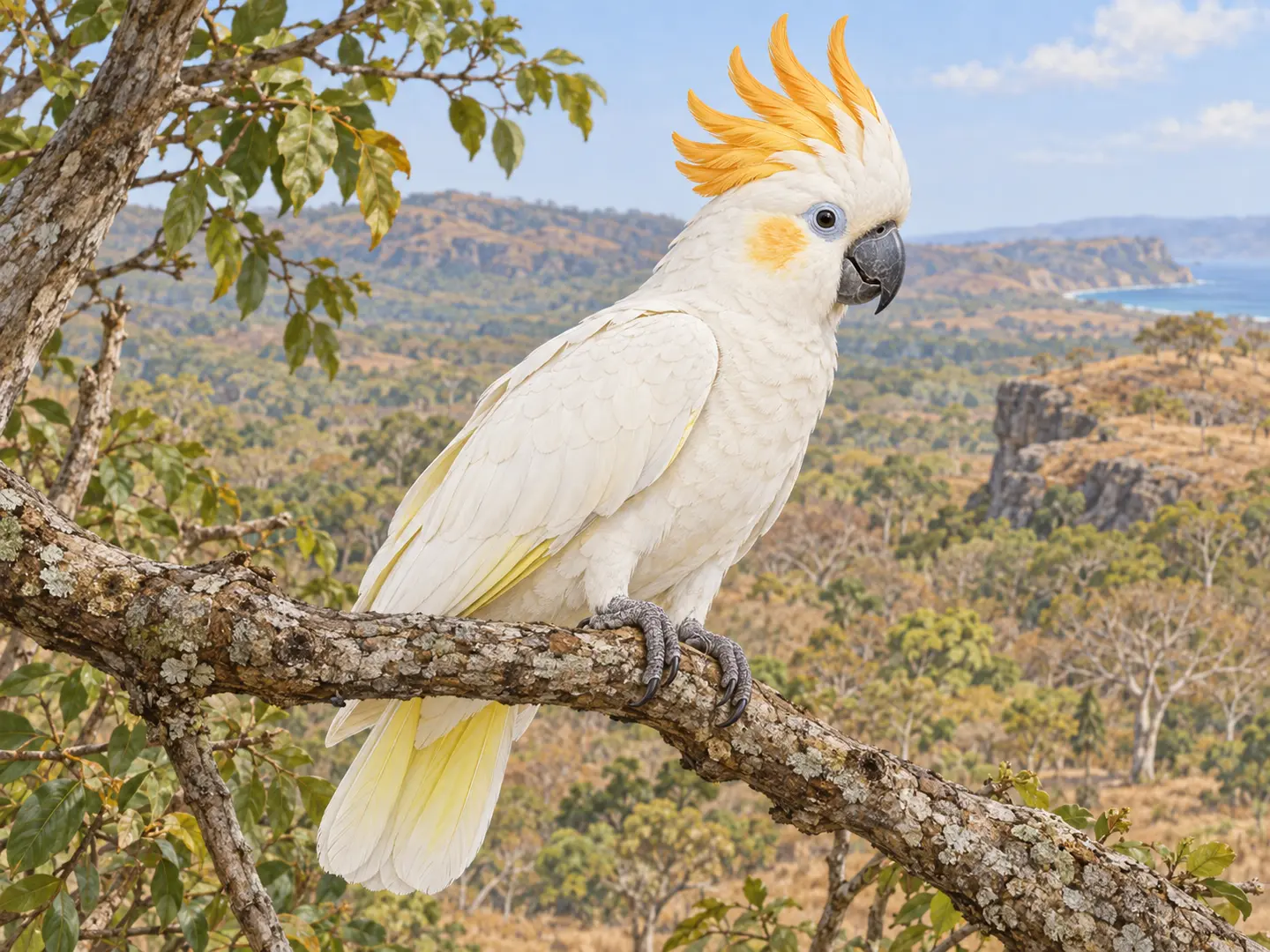
Native only to Sumba, Indonesia; uses forest, forest edge and wooded grassland where large hollow-bearing trees remain. [1,2]
Belfast records length up to about 50 cm and mass up to roughly 450 g; measurements vary by individual and taxonomic treatment. [2]
Mostly white with a curved citron-orange crest, orange-yellow ear patch, dark grey bill and yellow wash below the flight and tail feathers. Sexes are similar. [2]
A powerful curved bill and two-forward, two-backward toes manipulate food and aid climbing; crest and loud calls support signalling in wooded habitat. [2]
Behaviour and ecology
Lives in pairs or small groups, forages in the canopy and uses loud calls to maintain contact. The raised crest is a visual signal during alert or social interactions. [2; behavioural synthesis]
Diet
Feeds on seeds, nuts, fruit, berries and sometimes insects; the strong bill processes hard foods. [2]
Reproduction and life cycle
Nests in large tree hollows. Data for the C. sulphurea complex commonly report two eggs and shared incubation of about 28 days; this should not be treated as a universal husbandry prescription. [1,2]
Ecosystem role
Interacts with plants through seed and fruit feeding and cavity nesting; dependence on old trees makes forest structure important for reproduction. [1; ecological interpretation]
Threats & conservation
A tiny island range, loss of nest trees and historic capture for the pet trade have driven severe decline. Appendix I requires strict international-trade controls and direct permit verification. [1,2,3]
Reviewed 18 September 2026: BirdLife now treats this taxon as the species Cacatua citrinocristata, while many systems retain the subspecies C. sulphurea citrinocristata. CR and Appendix I were cross-checked through BirdLife, Belfast Zoo and the CITES Appendices effective 5 March 2026.5 sourced facts
Species in five facts
This taxon is endemic to the island of Sumba. [1,2]
BirdLife recognises it as the species Cacatua citrinocristata. [1]
Many systems retain the subspecies name C. sulphurea citrinocristata. [2]
Its citron-orange crest distinguishes it from many other white cockatoos. [2]
Belfast Zoo records CR status and CITES Appendix I. [2]
Sources
[1] BirdLife DataZone — Citron-crested Cockatoo[2] Belfast Zoo — Citron-crested cockatoo[3] CITES Appendices — effective 5 March 2026[Minh họa] DinoJura educational illustration — generated and reviewed 18 September 2026