
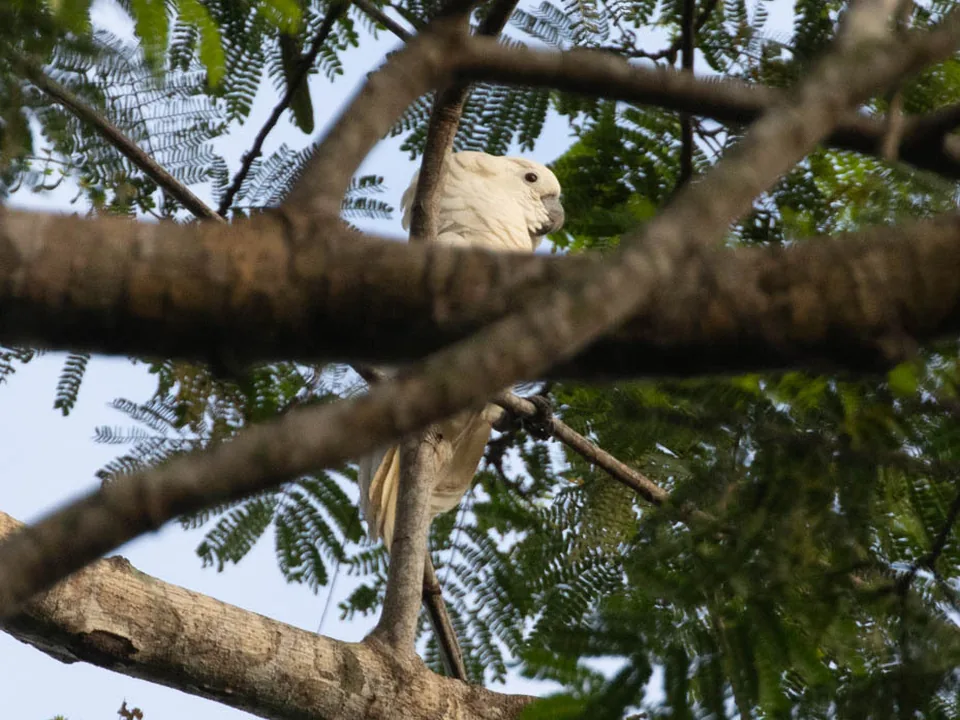
Native to Halmahera, Bacan, Ternate, Kasiruta, Tidore and Mandioli; some other island populations may be introduced. It uses forest, woodland, mangroves, swamps, river edges and farmed landscapes retaining large trees. [1,2]
Average length is about 46 cm and mass about 500–630 g. Females often have slightly smaller heads and bills; size alone is not a sufficient sexing criterion. [1]
White overall with yellowish underwings and undertail, a broad recurved crest that opens into a fan, dark grey bill and feet, and pale blue eye-ring. Male irides are commonly dark brown and female irides red-brown, but sexing requires care. [1]
A powerful curved bill and zygodactyl feet support climbing and food manipulation; crest display, posture and calls form a visual-acoustic signalling system. These abilities require three-dimensional space and manipulable materials in care. [1]
Behaviour and ecology
Diurnal, seen alone, in pairs or small groups that may gather into larger afternoon flocks. Climbing, object manipulation and social learning are well developed; poor behavioural choice and cognitive stimulation in care can produce abnormal behaviour. [1]
Diet
Feeds mainly on fruit, seeds and nuts, while also taking maize, insects and small lizards. Natural seed feeding does not justify a captive diet dominated by high-fat seed mixtures. [1]
Reproduction and life cycle
Nests in cavities of large trees, usually laying two eggs and occasionally three; both parents incubate for about 30 days. Young fledge at around three months and remain dependent for several more weeks. [1]
Ecosystem role
Fruit feeding contributes to seed dispersal, and vacated nest cavities may shelter or support breeding by other animals. Dependence on large trees also makes the species sensitive to selective logging. [1]
Threats & conservation
Capture for the bird trade, deforestation and hunting are major threats. CITES Appendix II regulates international trade; captive-bred origin must be demonstrated through continuous records, not a seller's claim alone. [2–4]
Reviewed 21 September 2026: BirdLife/IUCN currently records EN; Cacatua alba is in CITES Appendix II. Some older educational sources still show VU, so this profile uses the current category and records the review date.5 sourced facts
Species in five facts
The broad fan-shaped crest gives rise to the name “umbrella cockatoo”. [1]
The species is endemic to the northern Maluku island group. [1,2]
Both parents share incubation and care of the young. [1]
Crest, wings, tail and calls all contribute to social signalling. [1]
A clutch usually contains two eggs and incubation lasts about 30 days. [1]
Sources
[1] Animal Diversity Web — Cacatua alba[2] BirdLife DataZone — White Cockatoo[3] CITES Appendices effective 5 March 2026[Ảnh] iNaturalist observation 179478652 — avocat, CC BY