
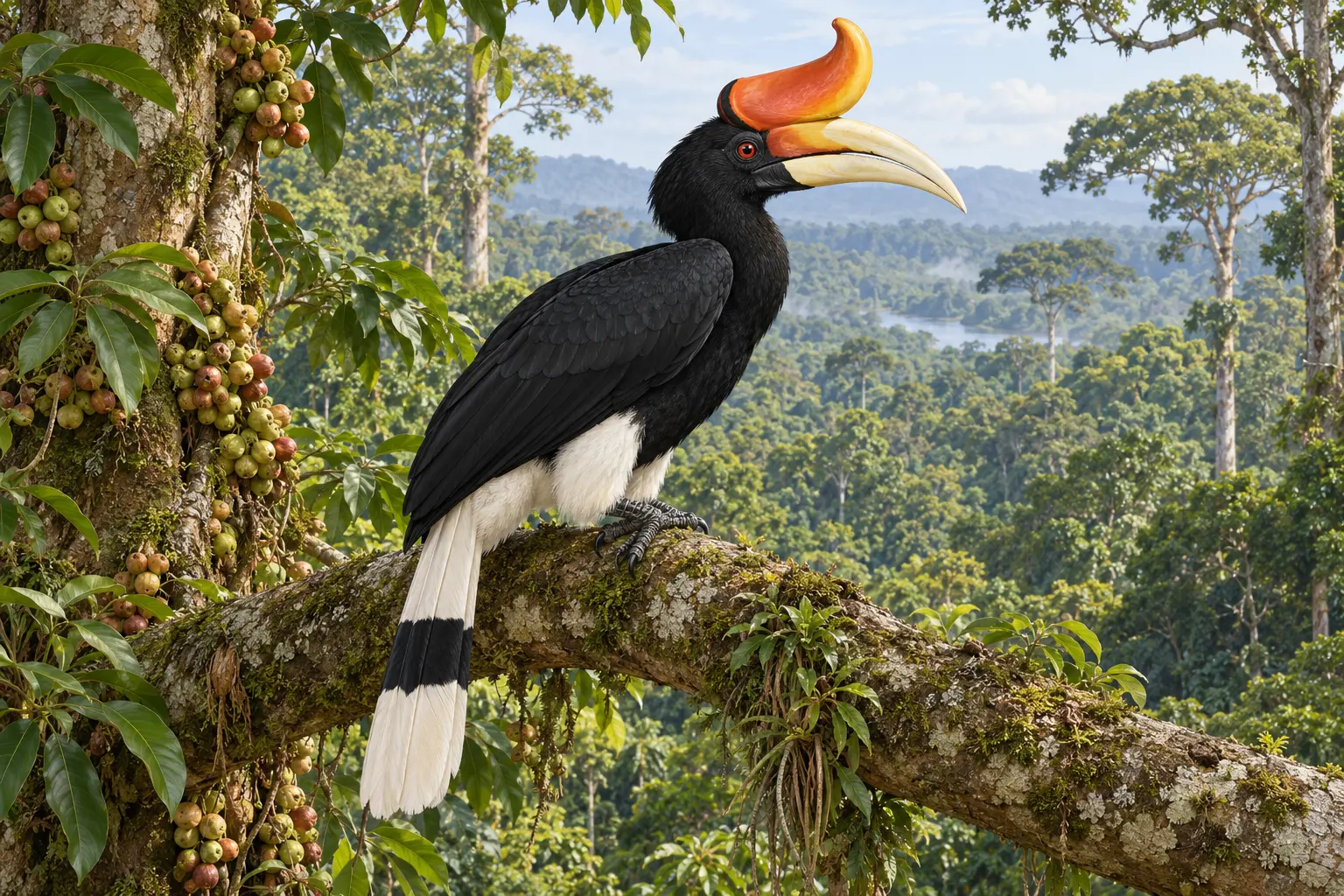
Occurs in far southern Thailand, Peninsular Malaysia, Sumatra, Borneo and Java and is locally extinct in Singapore. It is chiefly a mature lowland and evergreen rainforest bird, reaching about 1,400 m but especially affected by lowland forest loss. [1,2]
The IUCN Hornbill Specialist Group gives a length of 99–125 cm, males about 2.47–3.0 kg and females 2.04–2.33 kg. The casque enlarges the head's profile but is not a solid mammalian horn. [1]
Black plumage, white thighs and vent, and a white tail with a broad black band combine with a huge ivory bill and red-orange upcurved casque. Males have red eyes with dark orbital skin; females generally have white eyes and reddish orbital skin. Casque shape, eye colour and tail pattern separate it from other large hornbills. [1]
The long bill reaches fruit on thin branch tips without moving the whole body outward; fused first and second neck vertebrae help support the head. The casque may contribute to acoustic resonance and visual signalling, but its function should not be reduced to one role. [2,3]
Behaviour and ecology
Usually found in pairs or small family groups, travelling among fruiting trees and giving powerful calls. During breeding the female seals most of the nest-cavity entrance, leaving a slit through which the male supplies food; male reliability and nearby fruit availability are therefore critical. [1,3]
Diet
Diet is dominated by fruit, especially figs, but also includes insects, lizards, nestlings and other small animals. Fruit is often swallowed whole and seeds later defecated or regurgitated elsewhere; managed diets require veterinary oversight of iron exposure in fruit-eating hornbills. [1–3]
Reproduction and life cycle
It nests in natural cavities of large trees. The female enters, seals the entrance, moults and incubates while the male provisions through a slit. After the female breaks out, the chick may reseal the cavity until fledging. The long cycle means loss of one suitable nest tree can eliminate a breeding season. [1,3]
Ecosystem role
Large seeds are carried away from parent trees during long flights, supporting forest regeneration and plant gene flow. Protecting the hornbill therefore also means retaining seasonal fruit trees, veteran nest trees and canopy corridors. [1–3]
Threats & conservation
Logging, forest conversion, hunting and trade drive declines; trees with suitable cavities develop far more slowly than commercial plantation cycles. International transfer requires CITES, provenance and national-law checks; managed programmes need pedigrees and cannot substitute for forest conservation. [1,2,4]
Reviewed 1 October 2026: the IUCN Hornbill Specialist Group records Vulnerable (VU), assessed in 2018; BirdLife records CITES Appendix II. Global status does not replace subspecies provenance or national-law review, especially for live birds, feathers, bills and casques. [1–4]5 sourced facts
Species in five facts
Three recognised subspecies occupy different parts of the Sunda region. [1]
The female builds a wall that seals most of the nest entrance during breeding. [3]
Body length can exceed one metre. [1]
Figs are important food and their seeds are dispersed through the forest. [1–3]
The species is regulated under CITES Appendix II. [2,4]
Sources
[1] IUCN Hornbill Specialist Group — Rhinoceros Hornbill[2] BirdLife DataZone — Buceros rhinoceros[3] Cincinnati Zoo — Rhinoceros hornbill[4] CITES Appendices effective 5 March 2026