
The Reptile Database records north-western Madagascar, including Nosy Be and Nosy Komba. Research on the minima group shows habitat specialisation and narrow lowland-forest ranges. [1,2]
The B. minima group spans roughly 14–30 mm snout–vent and 22–48 mm total length; females tend to be larger and males relatively longer-tailed. Measurements of B. micra are not assigned to B. minima. [2]
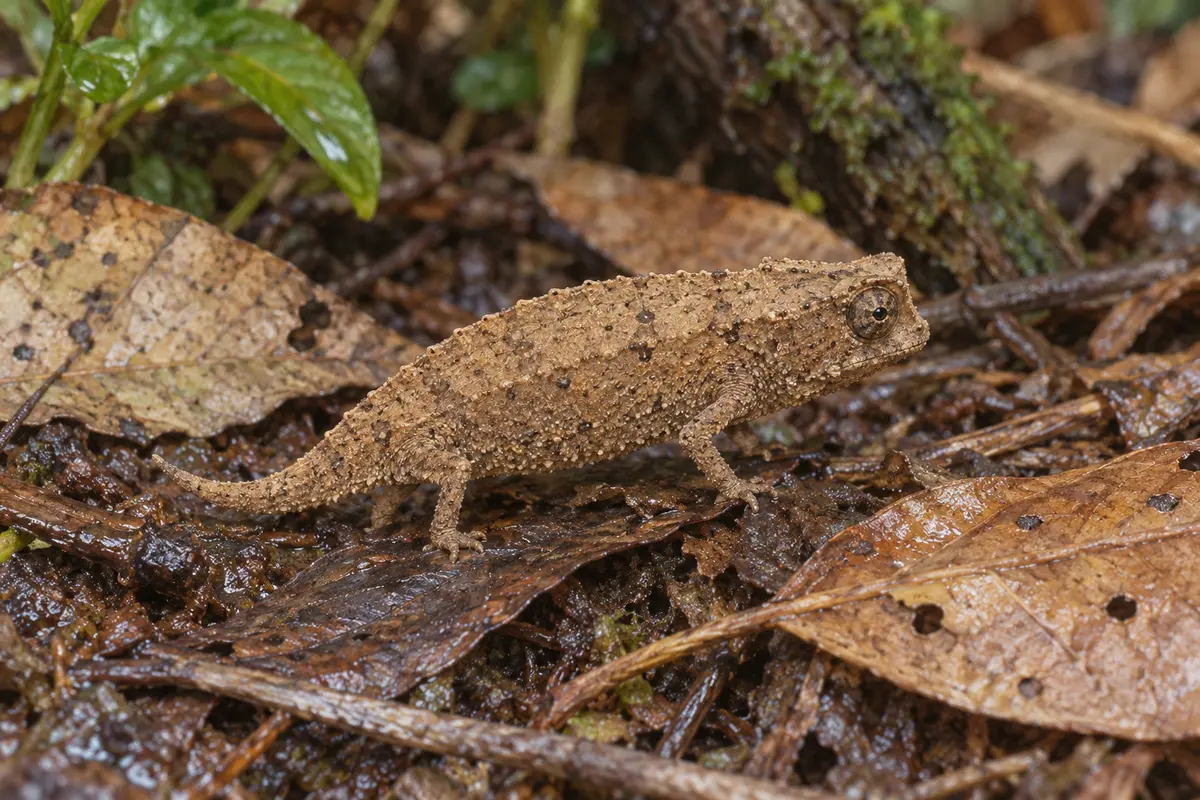
A tiny, flattened, granular brown-grey body resembles leaf litter; the tail is short, casque low and horns absent. Identification requires provenance, detailed morphology or expert data because miniature species look very similar. [1,2]
Miniaturisation, leaf-litter colour and a low body profile suit ground-level microhabitats. Genetic work shows deeply distinct lineages within the minima group despite superficial similarity. [2]
Behaviour and ecology
It operates close to the forest floor, moving slowly among litter and low twigs; muted colour and stillness reduce detection. Tall-canopy behaviour of larger chameleons should not be generalised to this species. [2]
Diet
Species-specific quantitative diet data remain limited; body size constrains it to very small forest-floor invertebrates. This is an ecological inference, not a tested captive diet list. [2]
Reproduction and life cycle
Brookesia are egg-laying, but the reviewed sources did not provide robust B. minima-specific laying frequency or incubation data. Clutch figures from B. micra, B. nana or other species are not transferred here. [2,4]
Ecosystem role
It consumes minute invertebrates and is potential prey for many forest-floor animals. Its quantitative ecosystem effect is insufficiently measured and should not be overstated. [2]
Threats & conservation
CITES records a small range, fragmented habitat, decreasing trend and forest loss from slash-and-burn agriculture and logging. Wild sourcing is subject to Appendix-II controls and non-detriment assessment. [3]
Reviewed 21 October 2026: CITES material reports EN, a decreasing trend and Appendix-II coverage under Brookesia spp. Historical trade data do not substitute for a current quota or permit. [2,3]5 sourced facts
Species in five facts
It is endemic to north-western Madagascar. [1]
B. minima belongs to a group containing some of the smallest amniotes. [2]
Miniature species may look similar yet be deeply genetically distinct. [2]
CITES previously recorded trade dominated by live, wild-sourced animals. [3]
Brookesia spp. are in Appendix II except separately listed exceptions. [4]
Sources
[1] Reptile Database — Brookesia minima[2] PLOS ONE — miniaturised Brookesia radiation[3] CITES Animals Committee — Brookesia minima trade review[4] CITES Appendices — Brookesia spp.