
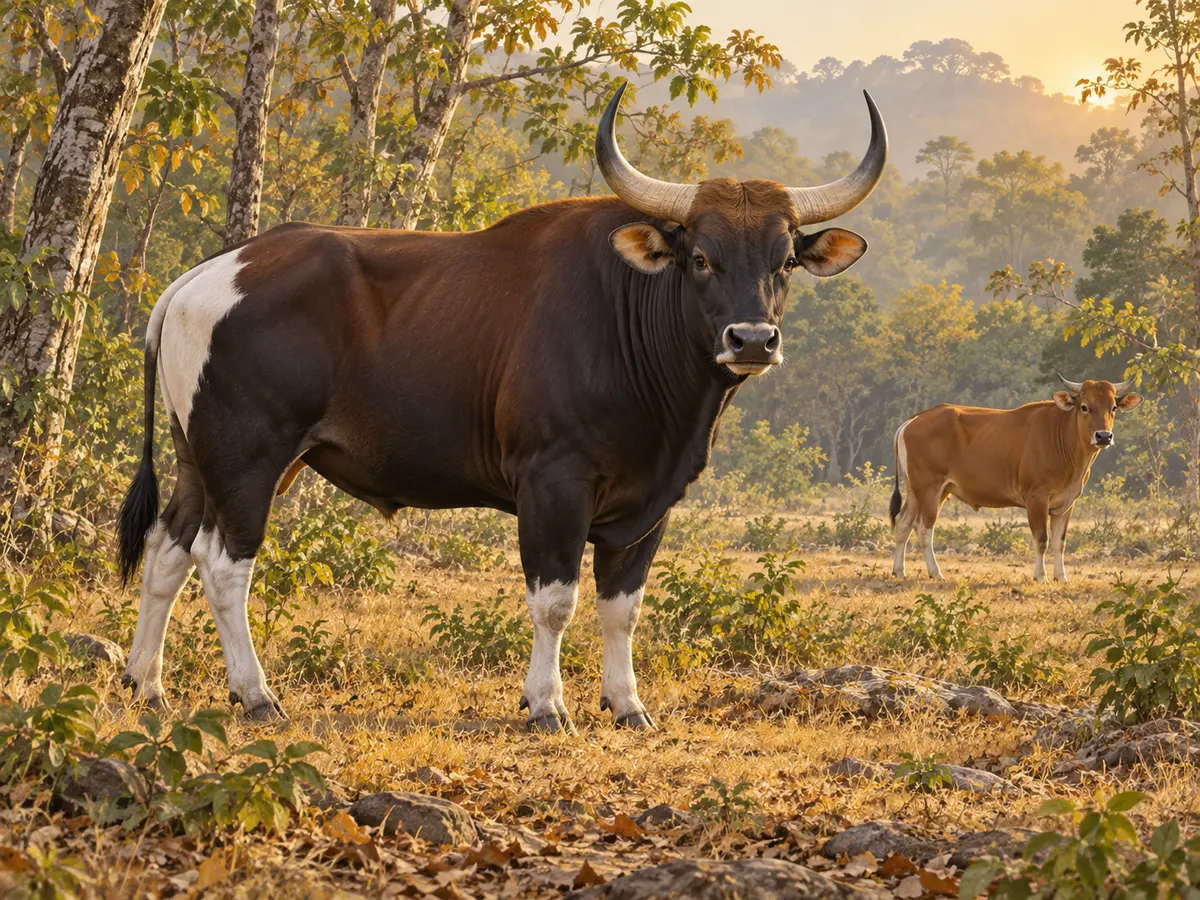
The remaining native distribution is fragmented across Cambodia, Indonesia, Malaysia, Myanmar, Thailand and Vietnam, within a formerly broader mainland and island Southeast Asian range. It uses dry and open forest, forest edges, grassland and areas near water. [1,4]
Body length is roughly 1.9–2.25 m and shoulder height may approach 1.6 m; large bulls can weigh several hundred kilograms, sometimes near 800 kg. Values vary by sex and subspecies and are not condition targets for every animal. [4]
Both sexes carry horns; males are generally darker with thick horns sweeping out and upward, while females are reddish-brown with slimmer horns. A white rump patch, white lower legs and pale muzzle band are conspicuous. [4]
A multi-chambered rumen ferments cellulose from grass and leaves; a large body and hooves suit movement between open forest and grassland. Sex-specific coat colour and white patches provide long-range visual signals. [4]
Behaviour and ecology
Females and young commonly form small herds, while adult bulls may be solitary or join during breeding. Where hunting and disturbance are intense, activity may shift increasingly into the night. [1,4]
Diet
Primarily grazes but also browses leaves, shoots and shrubs seasonally; water and mineral licks are important in many habitats. Managed diets should prioritise fibre, avoid excess energy and monitor hoof and rumen health. [4]
Reproduction and life cycle
Gestation lasts roughly 9–10 months and usually produces one calf. Calves depend on the mother, and delayed maturity plus spacing between births slows recovery after hunting losses. [4]
Ecosystem role
As a large herbivore, banteng alter sward height, create paths and redistribute nutrients in dung, while also providing potential prey for tigers and other large predators. [1,4]
Threats & conservation
Hunting for meat, habitat loss and fragmentation, competition, disease spillover and hybridisation with domestic cattle are major pressures. Under CR status, ex situ programmes require traceable founders, hybridisation controls and conservation goals; hybrids or domesticated stock do not replace wild populations. [1,4]
The current IUCN record lists Bos javanicus as Critically Endangered (CR); the EN assessment published in 2016 is marked by IUCN as superseded. The name was not located in the CITES Appendices effective 5 March 2026; absence from CITES does not replace wildlife protection and national law across range states. [1–3]5 sourced facts
Species in five facts
Adult males are usually much darker than females. [4]
The large white rump patch is a key field mark. [4]
Native banteng populations still occur in Vietnam. [1]
It usually bears one calf after roughly 9–10 months. [4]
Disease and hybridisation with domestic cattle can erode wild populations. [1,4]
Sources
[1] IUCN Red List search — current Bos javanicus record[2] IUCN legacy assessment — marked superseded[3] CITES Appendices effective 5 March 2026[4] Smithsonian's National Zoo — Banteng