
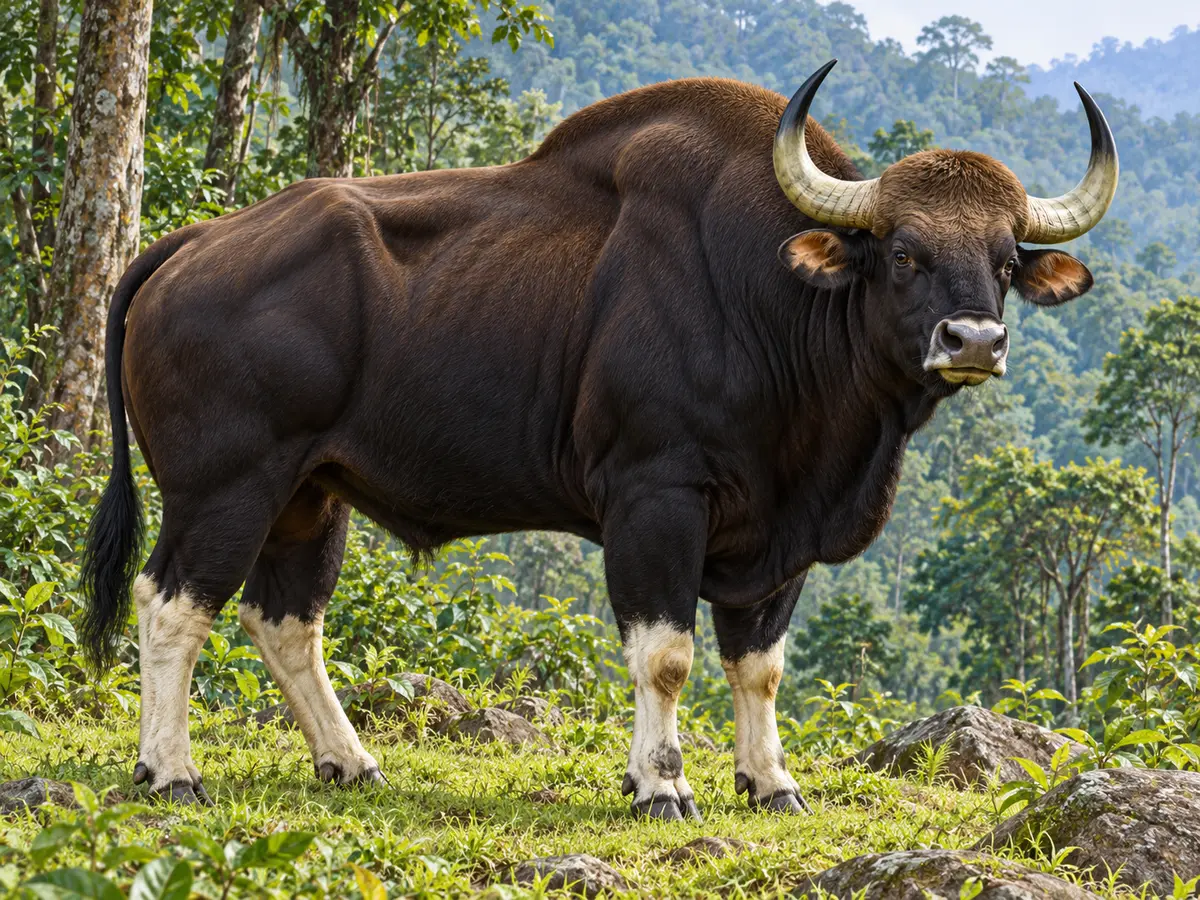
Patchily distributed from India, Nepal and Bhutan through Bangladesh, Myanmar, Thailand, Laos, Cambodia and Vietnam to Peninsular Malaysia. Habitats include evergreen, semi-evergreen and moist deciduous forest mosaics with grass, bamboo and water. [1–3]
Males may stand roughly 1.7–2.2 m at the shoulder and commonly weigh 650–1,000 kg, with exceptional animals heavier; females are markedly smaller. Sex and population must accompany comparisons, and maxima are not general standards. [1,2]
Dark brown to nearly black, with a pale-grey forehead, very high shoulders and a back sloping to the rump; both sexes bear pale greenish-yellow horns with dark tips and whitish lower legs. Water buffalo have different horn spread and build; gayal or mithun require separate management identity. [1,2]
Massive shoulder and neck muscles support movement on steep terrain and male contests; the rumen digests cellulose from fibrous plants. Broad hooves and strong legs aid travel on wet forest ground but do not remove slip or foot-disease risks in managed care. [1,2]
Behaviour and ecology
Herds commonly contain females and young, while adult bulls may be solitary or join temporarily. Feeding peaks in early morning and late afternoon, with shaded rumination; responses to people vary strongly with disturbance and hunting pressure. [1,2]
Diet
A ruminant grazer-browser taking grasses, bamboo, leaves, shoots, bark and seasonal fruit. Minerals and water matter, but artificial licks must be managed to avoid concentrating disease and conflict. [1,2]
Reproduction and life cycle
Usually gives birth to one calf after about 270–280 days of gestation; twins are rare. Calving season varies with region and forage, so one calendar should not be imposed on every population; mothers protect calves within the herd. [1,2]
Ecosystem role
Gaur shape vegetation through grazing and browsing, open paths and disperse seeds in dung; carcasses and calves also connect to predator and scavenger food webs. Protecting gaur corridors maintains connectivity for many other large forest species. [2,3]
Threats & conservation
Forest loss and fragmentation, hunting, conflict, livestock-borne disease and reduced forage or water are major pressures. DinoJura should not treat wild gaur as commercial stock; any rescue or transfer must be coordinated by authorities and capable institutions under Appendix I. [1,3,4]
IUCN lists the gaur as Vulnerable (VU) and decreasing. Bos gaurus is in CITES Appendix I; international commercial trade in wild-sourced specimens is tightly restricted. Wild gaur must not be conflated with domestic gayal or mithun in taxonomic or provenance records. [1,3,4]5 sourced facts
Species in five facts
The gaur is the largest living wild bovine. [1,2]
Both males and females carry horns. [1,2]
Pale lower legs form a distinctive stocking pattern. [1,2]
A birth usually produces a single calf. [1,2]
Bos gaurus is listed in CITES Appendix I. [4]
Sources
[1] Animal Diversity Web — Bos gaurus[2] Thai National Parks — Gaur[3] Vietnam gaur genome and conservation study (2025)[4] CITES Appendices effective 5 March 2026[5] IUCN Red List search — Bos gaurus