
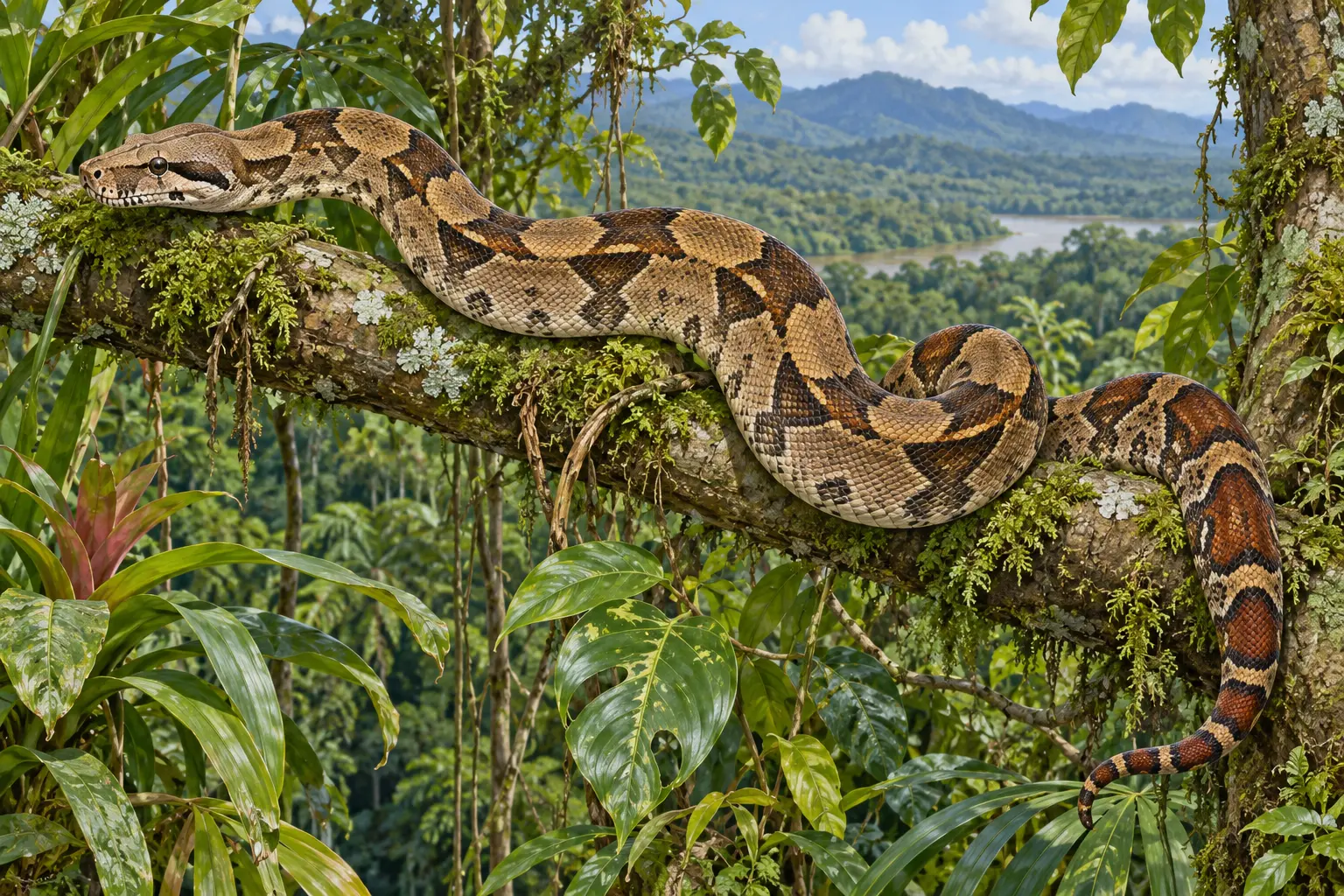
Under current taxonomy, Boa constrictor is centred in South America, with multiple subspecies and populations from the continent's north into Argentina. Accounts extending the species to Mexico or Central America often use an older concept including Boa imperator and should not establish specimen origin. [1–3]
Most adults are roughly 2–3 m long; females are generally larger and exceptional animals may approach 4 m. Mass varies greatly by subspecies, locality and body condition, so maximum values should not become growth targets or expectations. [2,3]
A robust snake with a grey-brown or tan ground colour and dark saddle-shaped blotches; the tail often becomes rich reddish-brown with black edging. The broad head carries an eye stripe but lacks the heat-sensitive pits of many other boids; pattern alone cannot confirm subspecies. [2,3]
Pattern breaks up the outline among litter, bark and forest floor, while the forked tongue collects chemical cues for the Jacobson's organ. Flexible spine, trunk muscles and skin distribute constriction pressure, and mobile jaws swallow prey whole without 'dislocating'. [2]
Behaviour and ecology
Mostly solitary and crepuscular-nocturnal, resting in cavities, hollow trees or vegetation by day. Juveniles are more arboreal; large adults spend more time on the ground but still use strong branches or ambush sites near prey routes. [2]
Diet
Takes appropriately sized mammals, birds and reptiles, from rodents to medium-sized mammals in large boas. Curved teeth secure prey before constriction rapidly impairs circulation rather than 'crushing bones'; live prey is unnecessary and inappropriate in routine care. [2]
Reproduction and life cycle
Live-bearing: embryos develop within the female and young emerge in thin membranes. Smithsonian summarises gestation near 5–8 months and litters of 10–64, averaging about 25; output varies with subspecies, body size and conditions. [2]
Ecosystem role
A mid-to-upper predator of rodents, birds and other animals, while young boas are prey for raptors, mammals and larger reptiles. Its ecological role shifts as juveniles move from more arboreal life toward the ground with growth. [2]
Threats & conservation
Habitat loss, hunting for skins or meat and pet collection create local pressure, while released boas can become non-native populations. Acquisition requires correct identification as Boa constrictor or Boa imperator, subspecies, captive source, permits and load-bearing enclosure planning across a 20–30 year lifespan. [1–4]
Reviewed 27 September 2026: IUCN published an LC assessment in 2021. CITES places Boa constrictor in Appendix II, except B. c. occidentalis in Appendix I. Older sources often include Central American boas now separated as Boa imperator, so range and permits must match current name, subspecies and locality. [1–4]5 sourced facts
Species in five facts
Boa constrictor gives birth to live young rather than laying eggs. [2]
Constriction primarily arrests circulation rather than crushing bones. [2]
Young boas tend to be more arboreal than large adults. [2]
Boa imperator is separated from Boa constrictor in the Reptile Database. [3]
CITES places B. c. occidentalis in Appendix I while the remainder is in Appendix II. [4]
Sources
[1] IUCN Red List species search — Boa constrictor[2] Smithsonian's National Zoo — Boa constrictor[3] The Reptile Database — Boa constrictor[4] CITES Appendices effective 5 March 2026