
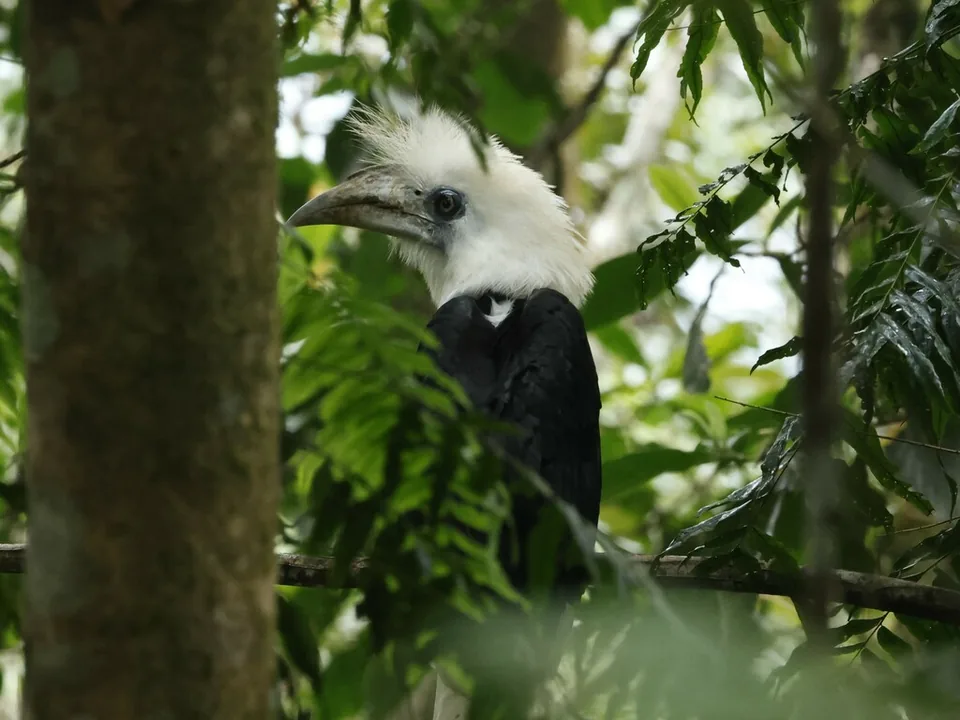
Patchily distributed from southern Myanmar and Thailand through Peninsular Malaysia to Sumatra and Borneo. It lives mainly in lowland and foothill evergreen forest, especially mature stands retaining large trees. [1,2]
Total length is about 83–102 cm, much of it contributed by the long tail; mass is commonly around 1.3–1.5 kg. Males are generally larger with a more developed bill and casque. [1]
Both sexes have a long shaggy crest and black-and-white tail. Males show conspicuous white on the head, neck and upper breast; females are darker around the head and neck. A large bill, low casque and bare orbital skin aid identification at close range. [1]
The long bill reaches fruit and prey beyond the feet, while fused neck vertebrae stabilise the head–bill system. Sealed-cavity nesting reduces some predation risk but makes the family highly dependent on the male and a suitable nest tree. [1]
Behaviour and ecology
Diurnal in the canopy and middle storey, usually seen in pairs or family parties. Birds search branches, foliage and cavities for prey; loud calls maintain contact in dense forest. [1]
Diet
Takes fruit but also substantial animal prey including large insects, lizards, nestlings, eggs and other small animals. This omnivory does not justify a uniformly high-protein diet throughout the year in managed care. [1]
Reproduction and life cycle
Nests in natural tree cavities. As in many hornbills, the female seals herself behind a narrow slit through which the male passes food during incubation and early chick rearing. [1]
Ecosystem role
By dispersing forest-tree seeds while also preying on insects and small animals, the species links several trophic levels. Protecting nest and fruit trees also preserves habitat structure used by many other species. [1,2]
Threats & conservation
Loss and degradation of lowland forest, removal of large trees and hunting are major pressures. Appendix-II paperwork does not replace welfare requirements: the species needs flight space, canopy structure, social management and specialised nesting provision. [1–3]
Reviewed 22 September 2026: BirdLife/IUCN records EN; Bucerotidae, including Berenicornis comatus, are in CITES Appendix II except taxa listed at a higher level. Exact name and country rules must be checked for every transaction.5 sourced facts
Species in five facts
Its English name refers to the long, shaggy white crown feathers. [1]
It consumes more animal prey than many strongly fruit-eating hornbills. [1]
The female remains inside a sealed cavity while the male delivers food through a narrow slit. [1]
The long tail contributes substantially to a total length exceeding 80 cm. [1]
Borneo, Sumatra and the Malay Peninsula all form part of the native range. [1,2]
Sources
[1] Animal Diversity Web — Berenicornis comatus[2] BirdLife DataZone — White-crowned Hornbill[3] CITES Appendices effective 5 March 2026[Ảnh] iNaturalist observation 229103562 — CC0