
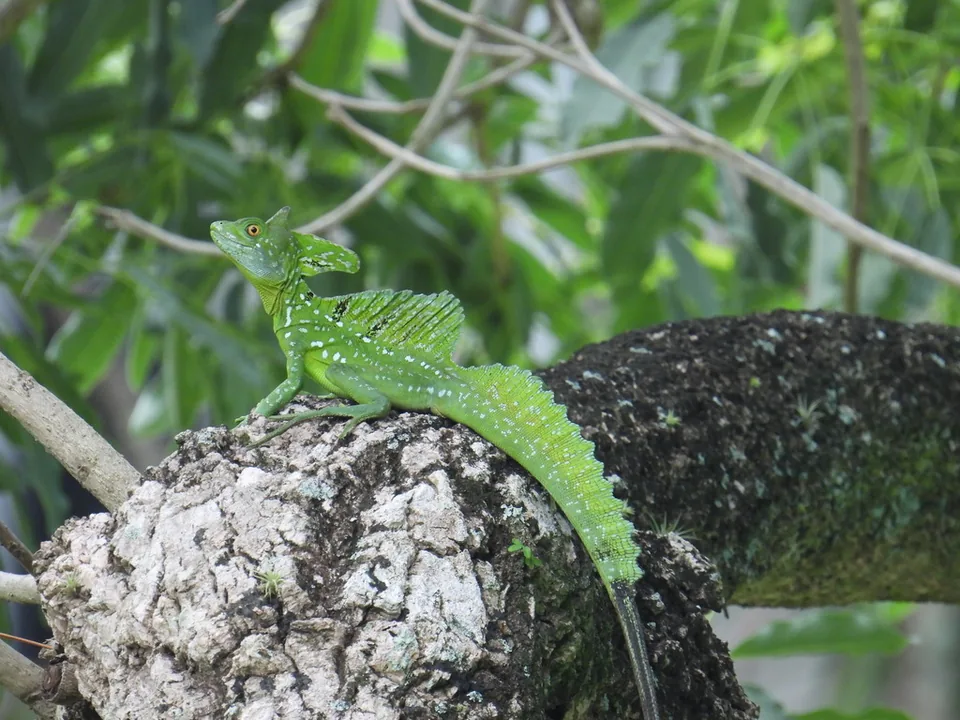
Recorded in Costa Rica, Honduras, Nicaragua and Panama, usually in tropical rainforest beside rivers, streams or other water bodies from sea level to about 775 m. [1,2]
May reach about 90 cm in total length, much of it tail; adult males are larger and carry more developed crests than females. [1]
Laterally compressed and bright green with white, grey or pale-blue markings; long hind limbs and flattened toes. Males have conspicuous head, back and tail crests, reduced in females and juveniles. [1,2]
Powerful hind limbs, long toes and specialised scales under the feet generate force and temporary air pockets during fast water runs; the compressed tail assists swimming. [1]
Behaviour and ecology
Often basks on waterside vegetation and dives when threatened. It can run bipedally across water, then swim and dive; Smithsonian records submergence exceeding 10 minutes. [1]
Diet
An opportunistic feeder taking insects, spiders, snails, small crustaceans, smaller lizards and other small vertebrates; diet varies by locality. [1]
Reproduction and life cycle
Oviparous, burying eggs in soil. Smithsonian summarises clutches of 15–17 eggs and incubation of about 8–10 weeks; females may lay multiple clutches in a season. [1]
Ecosystem role
A mid-sized predator in streamside food webs, consuming diverse invertebrates while also serving as prey for raptors, snakes and mammalian predators. [1; ecological interpretation]
Threats & conservation
Smithsonian identifies habitat loss from development and occurrence in the pet trade, while noting collection impacts need more research. Lawful origin and welfare require separate checks. [1]
Reviewed 18 September 2026: Smithsonian describes the species as relatively common within its range, but its interface did not permit a reliable IUCN-category confirmation. A direct CITES species record was not retrievable; DinoJura does not infer an Appendix or trade entitlement.5 sourced facts
Species in five facts
It can run bipedally across water for short distances. [1]
Smithsonian reports submergence for more than 10 minutes. [1]
Males carry four crest regions along the head, back and tail. [1]
Total length may reach about 90 cm. [1]
The cited synthesis places sexual maturity at roughly 18–24 months. [1]
Sources
[1] Smithsonian’s National Zoo — Green crested basilisk[2] Reptile Database — Basiliscus plumifrons[Ảnh] iNaturalist observation 120377877 — Josiah Londerée, CC BY