
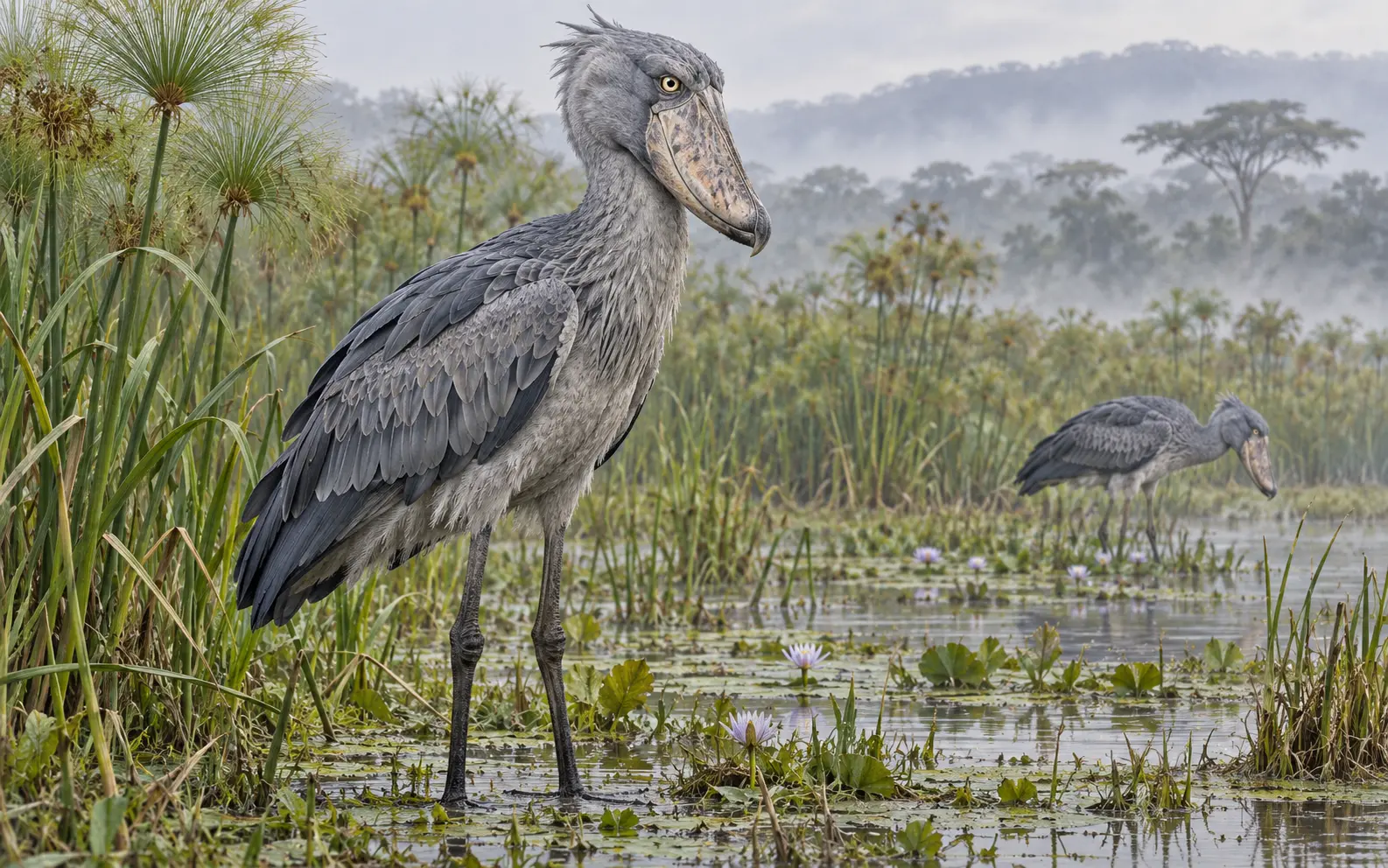
Patchily distributed in papyrus swamps and freshwater wetlands from South Sudan, Uganda and eastern DRC to Zambia, requiring shallow water with floating vegetation.
About 110–140 cm tall, with a wingspan around 2.3–2.6 m and mass around 4–7 kg; males average larger.
Huge head, thick neck and broad straw-coloured bill ending in a sharp hook; adults are grey with long legs. It is not a true stork and is evolutionarily closer to pelicans.
The broad bill grips large fish and vegetation, while its hooked tip secures slippery prey; stillness avoids alerting fish in turbid water.
Behaviour and ecology
Hunts alone by standing motionless for long periods before lunging bill and body into the water. Bill-clattering occurs, especially around nests.
Diet
Feeds on fish—especially lungfish, catfish and tilapia—plus amphibians, water snakes and occasionally other small animals.
Reproduction and life cycle
Builds a large nest on floating vegetation; typically lays 1–3 eggs, though often only one chick fledges. Parents may wet or shade eggs and chicks during heat.
Ecosystem role
A high-level wetland predator whose presence reflects functioning swamp habitat and fish populations.
Threats & conservation
IUCN lists it as VU, with declines driven by wetland loss, burning and drainage, nest disturbance, hunting and illegal capture. CITES Appendix II regulates international trade.
IUCN/CITES status was checked on the profile date; re-verify before any legal or transaction decision.5 sourced facts
Species in five facts
Balaeniceps rex roughly means 'whale-head king'.
It is the sole living species in its family.
Its hunting depends heavily on patience and stillness.
Lungfish are important prey in many swamps.
Nests are vulnerable to water-level changes and fire.
Sources
BirdLife DataZone — ShoebillSan Diego Zoo Wildlife AllianceCITES Checklist