
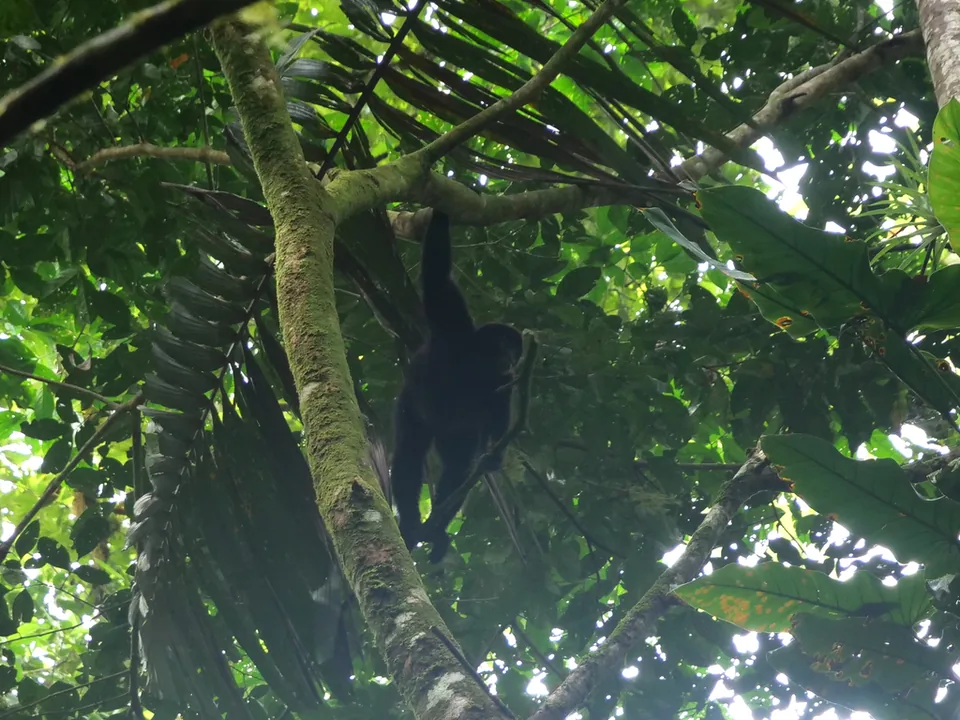
Associated with humid forests of western Colombia and Ecuador; some taxonomic treatments extend the range into Panama through subspecies A. f. rufiventris. It favours mature high-canopy forest but also uses connected secondary forest. [1,2]
Head–body length is about 40–55 cm, the tail about 70–85 cm, and mass commonly near 9 kg. The tail can exceed body length and has a nearly bare friction pad underneath its tip for gripping. [1]
A slender body, very long limbs, hands lacking a functional thumb and a strong prehensile tail are characteristic. The nominate brown-headed form has a dark brown head contrasting with a blackish-brown body; colour alone cannot establish subspecies or origin. [1]
A prehensile tail with a sensitive gripping pad, mobile shoulders, long curved fingers and a reduced thumb form an efficient branch-travel system. Forward-facing eyes support depth judgement across canopy gaps. [1]
Behaviour and ecology
Diurnal and canopy-dwelling, travelling by arm-swinging, climbing and long leaps. A larger community repeatedly splits into small foraging parties and reunites, helping track patchily distributed fruit. [1]
Diet
Soft ripe fruit dominates the diet, supplemented by young leaves, seeds, flowers, insects and occasionally eggs. Proportions vary by season and site, so data from one population are not a universal husbandry formula. [1]
Reproduction and life cycle
Usually one infant follows a gestation of about 227 days. Young cling to the mother, may not be weaned until around 20 months, and females mature slowly; these traits make recovery from decline very slow. [1]
Ecosystem role
By swallowing fruit and depositing seeds far from parent trees, spider monkeys support forest regeneration. Their loss can alter seed-dispersal networks, especially for large-fruited and large-seeded trees. [1]
Threats & conservation
Deforestation, fragmentation, hunting and capture of young are major pressures. CR status and slow reproduction require any managed-care programme to have a conservation purpose, suitable social groups, three-dimensional space and continuous provenance records. [1–3]
Reviewed 22 September 2026: IUCN records CR; Ateles fusciceps is in CITES Appendix II. Subspecies limits and range are treated differently among sources, so provenance records must use the scientific name, locality and individual history.5 sourced facts
Species in five facts
The tail tip has a bare gripping pad that functions much like a palm. [1]
The species has almost no functional thumb, allowing the hand to hook branches during suspension. [1]
A community repeatedly splits into smaller parties and reunites during the day. [1]
A birth usually produces one infant, and intervals between births can span years. [1]
Its ability to swallow large fruits lets it transport seeds that many smaller animals cannot disperse. [1]
Sources
[1] Animal Diversity Web — Ateles fusciceps[2] IUCN Red List species search[3] CITES Appendices effective 5 March 2026[Ảnh] iNaturalist observation 344815645 — CC0