
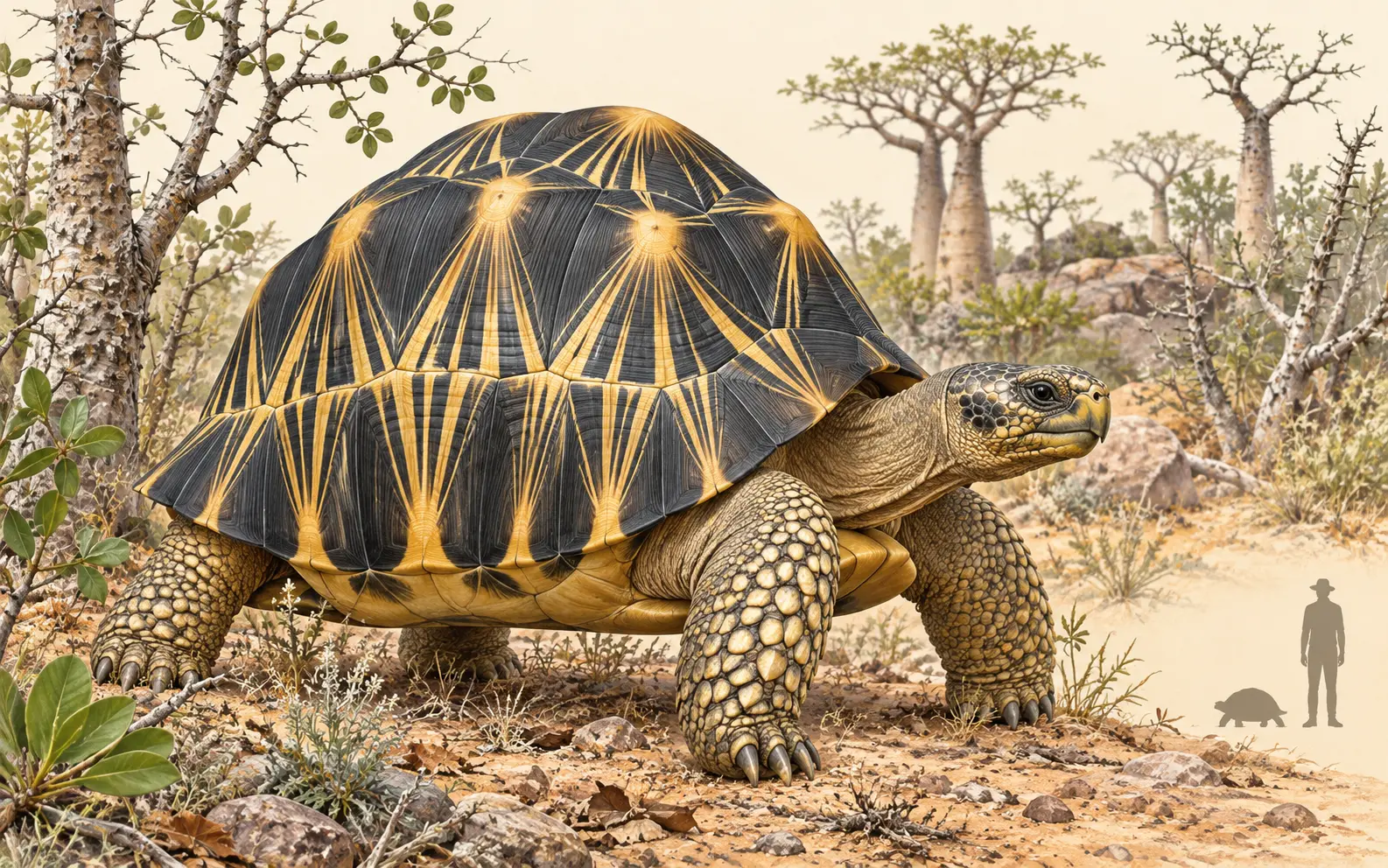
Native to far southern and south-western Madagascar, mainly spiny forest, dry scrub and woodland; introduced to several other islands.
Carapace length can reach about 41 cm and mass about 16 kg; males generally have longer tails and a more pronounced plastral notch.
Smooth, high-domed dark shell with fine yellow rays; yellow head and limbs, often with a dark crown patch. Its pattern differs from the Indian star tortoise and cannot determine exact age.
Columnar limbs support the body on dry ground, while the domed shell is living protective tissue with blood supply and nerves. Radiating patterns break up the outline in dappled spiny-forest light.
Behaviour and ecology
Diurnal and terrestrial, with activity often increasing after rain. Slow movement does not imply minimal space or microclimate choice.
Diet
Herbivorous, naturally feeding mainly on grasses, young growth, fruit and succulents. In human care, high fibre and controlled energy matter more than protein-rich food.
Reproduction and life cycle
Females excavate nests of roughly 3–12 eggs; incubation commonly lasts about 5–8 months. Late maturity and limited recruitment slow population recovery.
Ecosystem role
A grazer and seed disperser whose foraging influences low vegetation in Madagascar's dry ecosystems.
Threats & conservation
Collection for food and trade, together with spiny-forest loss, are major pressures. CITES Appendix I generally prohibits international commercial trade in wild specimens; any exception requires authority confirmation.
IUCN/CITES status was checked on the profile date; re-verify before any legal or transaction decision.5 sourced facts
Species in five facts
Yellow rays extend from the centre of each carapace scute.
The shell contains nerves and blood vessels, so touch can be sensed.
It favours fresh growth, while the natural diet remains fibre-oriented.
Hatchlings are only a few centimetres long yet soon develop the domed form.
It is a Madagascar endemic, not the Indian star tortoise.
Sources
IUCN Red List searchCITES ChecklistSmithsonian's National Zoo — Radiated tortoise