
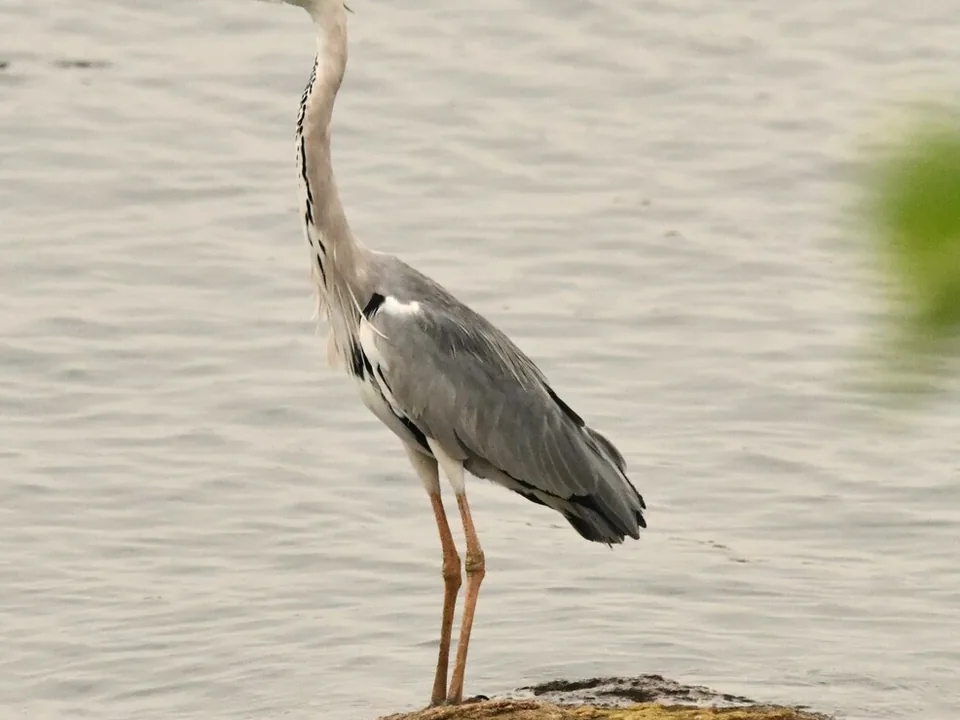
Widely distributed across Europe, much of Asia and parts of Africa. It uses rivers, lakes, ponds, marshes, flooded fields, estuaries and coasts; some populations migrate seasonally while others are resident. [1–4]
RSPB reports a length of about 90–98 cm and a 175–195 cm wingspan; ADW gives a broader length range of 84–102 cm. Differences reflect samples and methods, so a range is more useful than a single absolute figure. [2,4]
Adults have grey back and wings, a white head and neck, a black eye-stripe and crest, and a long yellow-orange bill; juveniles are browner-grey with less contrasting heads. Long legs and spreading toes support movement on mud and in shallow water. [2–4]
The long S-folded neck stores power for a rapid bill strike, while more forward-directed vision when targeting helps judge distance. A pointed bill, long legs and spreading toes form an integrated shallow-water hunting system. [2–4]
Behaviour and ecology
Usually forages alone by standing still, walking slowly or watching from a bank before stabbing at prey. During breeding, many pairs nest colonially in tall trees; outside breeding, birds may aggregate where food is abundant. [2–4]
Diet
Fish are important, but the species also takes amphibians, insects, crustaceans, small rodents and occasionally young birds. Diet varies with habitat and opportunity; the Grey heron should not be described as fish-only. [2–4]
Reproduction and life cycle
A stick nest is usually placed high and may be repaired and reused. BTO reports a typical clutch of 3–4 eggs, incubation by both parents for 26–27 days and fledging at about 50–55 days. [3]
Ecosystem role
The Grey heron is a predator at the water-land boundary, moving energy from fish and small animals to higher trophic levels. Nest colonies also concentrate nutrients beneath trees, although the effect depends on local colony size. [2–4]
Threats & conservation
The species remains LC globally, but pollution, wetland loss, fishing tackle and conflict at fish ponds can cause local mortality. Rescue or intake must avoid unauthorised capture and address tackle injuries, avian influenza and local wild-bird rules. [1–3]
The 2019 IUCN assessment lists Ardea cinerea as Least Concern (LC). The name was not located in the CITES Appendices effective 5 March 2026; this does not replace national wild-bird protection, veterinary, quarantine or transport requirements. [1,5]5 sourced facts
Species in five facts
The neck retracts in flight while the long legs trail behind. [3,4]
A typical clutch contains 3–4 eggs. [3]
Both parents incubate for about 26–27 days. [3]
The oldest ringed bird in BTO data exceeded 23 years. [3]
The bill launches rapidly from the folded-neck posture to seize prey. [2,4]
Sources
[1] IUCN Red List 2019 — Ardea cinerea[2] RSPB — Grey heron[3] British Trust for Ornithology — Grey Heron[4] Animal Diversity Web — Ardea cinerea[5] CITES Appendices effective 5 March 2026Photo record — Surabhi Srivastava, iNaturalist 175683345, CC BY