
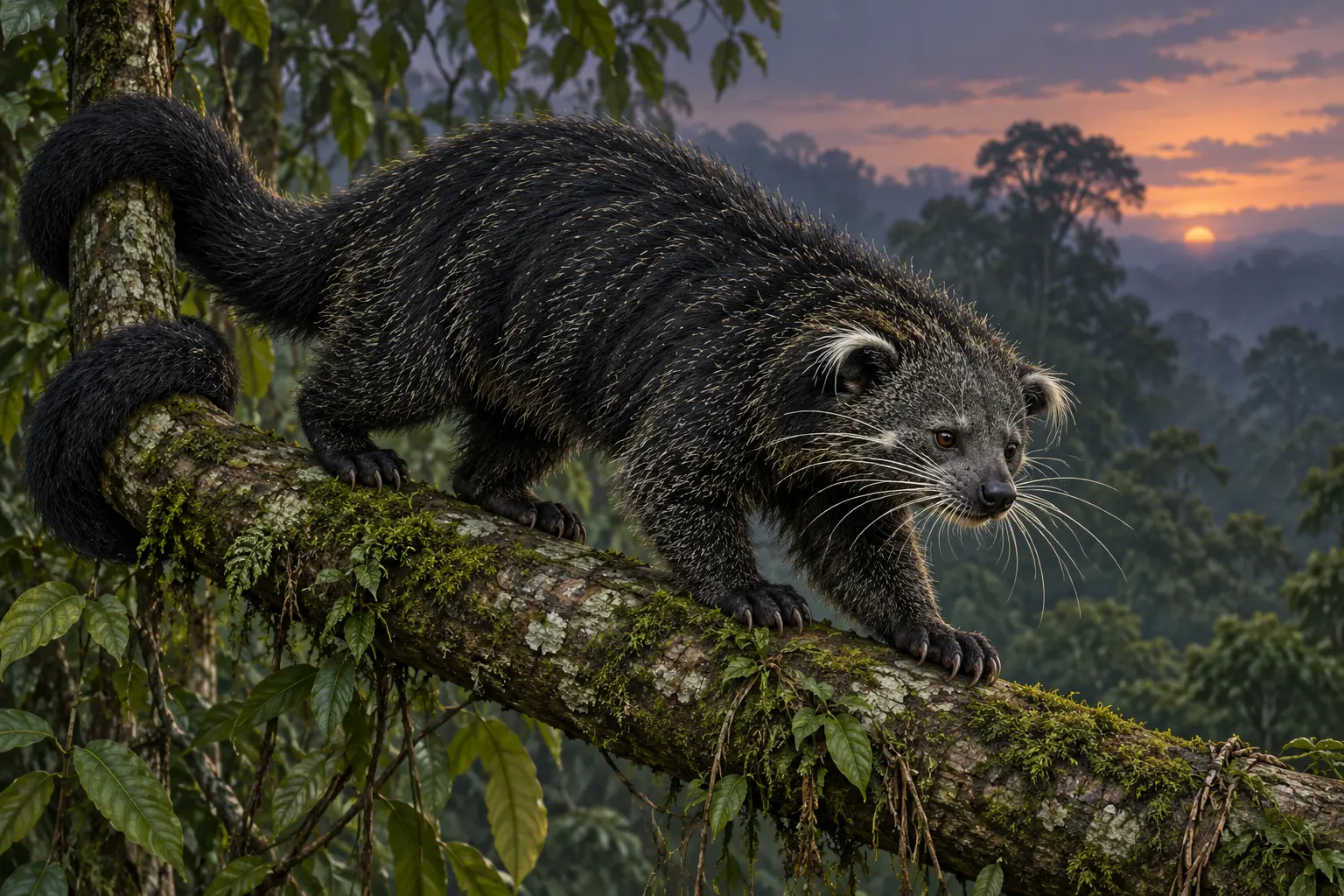
Ranges from north-eastern India and Nepal through Bangladesh, southern China and Southeast Asia to Sumatra, Borneo and Java. It is mainly associated with tropical forest and canopy continuity, while also occurring in secondary or fragmented landscapes that retain large trees. [1–3]
Smithsonian reports a head-body length of roughly 60–90 cm, a near-equivalent tail and a mass of about 11–36 kg; females are generally larger than males. This broad range is not a universal weight standard for all subspecies. [1]
Long, low and robust, with shaggy black silver-tipped fur, round white-edged ears, long white whiskers and a muscular tail with a bare calloused gripping surface near the tip. Its plantigrade gait differs from many smaller civets. [1,2]
A prehensile tail, flexible ankles and plantigrade feet maintain balance on branches, and the hind feet can rotate for head-first descent. A popcorn-like scent is associated with 2-acetyl-1-pyrroline in urine scent marks. [1,2]
Behaviour and ecology
Mostly crepuscular to nocturnal, a slow but secure climber and generally solitary outside breeding. Binturongs also descend to travel or feed; the prehensile tail is an anchoring aid rather than a permanent full-body suspension device. [1,2]
Diet
Omnivorous but strongly fruit-oriented, especially taking figs, while opportunistically eating leaves, eggs, insects, birds, fish, small mammals and carrion. Managed diets should not turn the Carnivora label into a meat-heavy ration and require veterinary attention to frugivorous physiology. [1,2]
Reproduction and life cycle
One of the few carnivorans capable of delayed implantation, allowing flexible birth timing. Smithsonian reports gestation around 90–92 days and usually two young; these are compiled values and require individual and subspecies records. [1]
Ecosystem role
It swallows fruit and disperses seeds in faeces; experimental work shows that gut-passed seeds can germinate, although effects differ among plants. Conserving binturongs therefore supports forest-regeneration links, not just a carnivore species. [3,4]
Threats & conservation
Forest loss and fragmentation, hunting for meat, pet trade and body-part use drive decline. Managed habitats require load-bearing elevated structure, travel distance, privacy and scent management; origin and Appendix III documents must be checked for the exporting country. [1,3,5]
Reviewed 3 October 2026: the 2016 IUCN assessment lists the species as Vulnerable (VU); CITES includes Arctictis binturong in Appendix III at India's request. Documentation depends on country of origin and trade route, so each movement requires authority review rather than relying only on the Appendix label. [1,3–5]5 sourced facts
Species in five facts
Females are generally larger than males. [1]
The prehensile tail may be nearly as long as the head and body. [1,2]
Its scent marking is often described as smelling like popcorn. [1,2]
Binturongs can delay embryo implantation. [1]
Its fruit-eating role helps disperse forest seeds. [3,4]
Sources
[1] Smithsonian’s National Zoo — Binturong[2] Animal Diversity Web — Arctictis binturong[3] Oryx (2024) — Binturong ecology and conservation[4] Raffles Bulletin of Zoology — Gut passage and seed germination[5] CITES Appendices effective 5 March 2026