
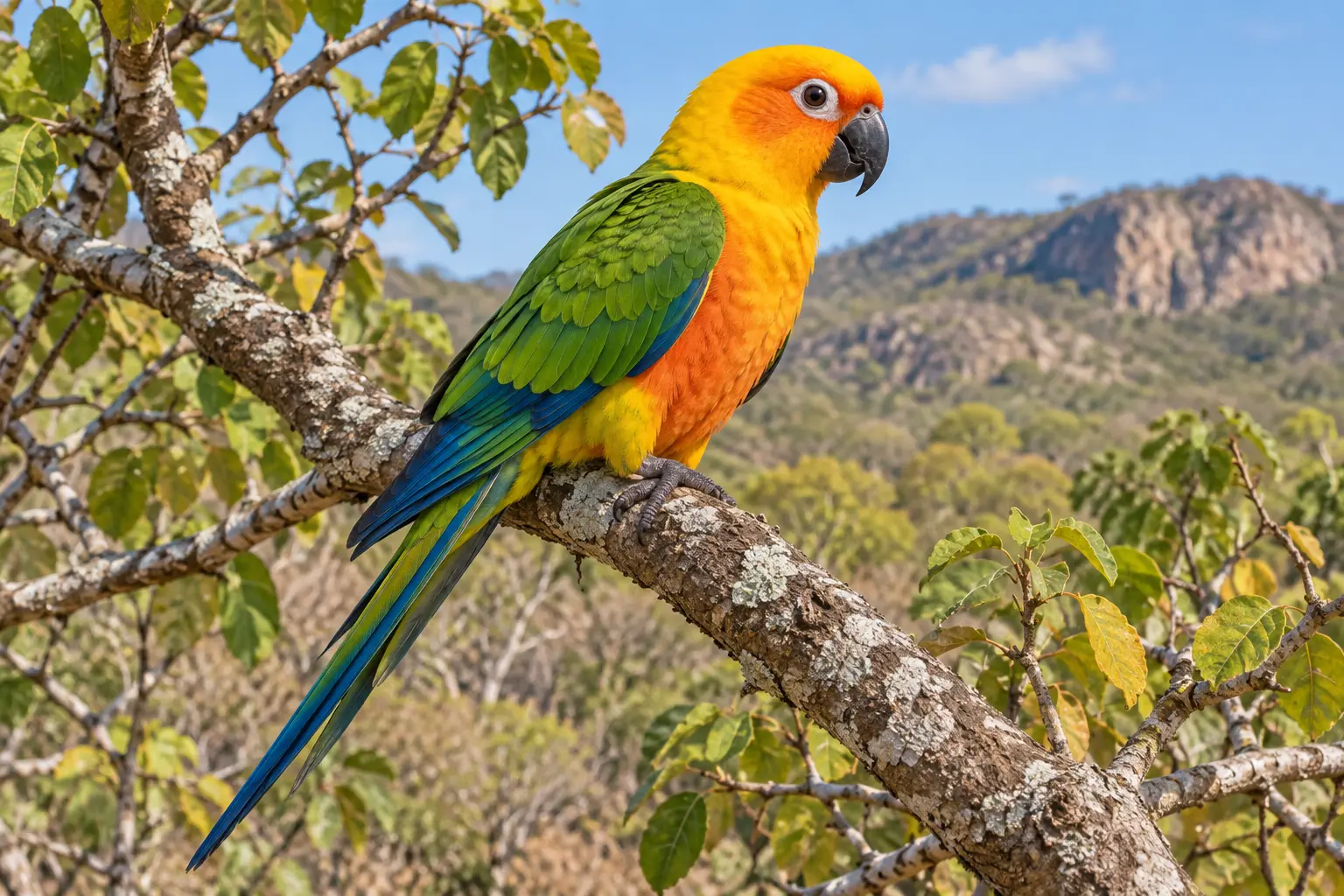
Native to north-eastern Brazil. Zoo references record semi-deciduous forest and adjacent open areas, so wooded patches, edges and cavity trees matter alongside closed-forest interiors. [1,2]
About 30 cm long and approximately 150 g according to United Parks & Resorts. These are adult reference values, not health thresholds for every individual. [2]
Yellow head and neck, orange-red cheeks and upper breast, orange belly, green back and wings, long blue-green tail, black bill and white bare eye ring. Confusion with Sun parakeets and captive hybrids means whole-plumage pattern, parent records and provenance should be combined. [1,2]
A strong hooked bill works with zygodactyl feet for climbing, gripping and rotating food. The long tail aids manoeuvring among branches, while vocal learning and social memory support contact in visually obstructed habitat. [2]
Behaviour and ecology
Usually encountered in pairs or small feeding groups in the canopy. It may spend long periods inside nest cavities even outside breeding; calls maintain contact through foliage. Sociality does not mean unfamiliar individuals can be mixed without compatibility monitoring. [2]
Diet
Feeds on seeds, fruit and nuts; the strong bill opens food while two-forward, two-back toes manipulate it. Managed diets should be varied and nutritionally balanced under veterinary guidance rather than relying solely on fatty seed mixes. [2]
Reproduction and life cycle
A cavity nester. Institutional summaries report 3–5 eggs, about 30 days of incubation and sexual maturity around 1–3 years; these management figures vary and do not replace pair-specific breeding records. [2]
Ecosystem role
While feeding on fruit and seeds, parakeets may both destroy seeds and move some seeds or fruit material among trees. The net effect varies by plant and handling method, so parrots should not automatically be labelled positive seed dispersers. [1,2]
Threats & conservation
Habitat loss and capture for the pet trade may affect local populations even though the global trend is recorded as stable. Managed programmes need pedigrees to avoid hybridisation with close relatives, and CITES plus national law must be verified before trade. [1–4]
Reviewed 2 October 2026: BirdLife/IUCN lists the species as Least Concern (LC), assessed in 2016; CITES regulates Aratinga jandaya under Appendix II. LC does not permit unrestricted collection or trade; permits, provenance and Brazilian/import-country law still require transaction-level review. [1,3,4]5 sourced facts
Species in five facts
The bird is about 30 cm long, with the tail contributing substantially to that length. [2]
An orange-red breast contrasting with green wings is a key adult feature. [2]
Reported clutches commonly contain 3–5 eggs. [2]
Individuals may remain in nest cavities for long periods even when not breeding. [2]
International trade is controlled under CITES Appendix II. [4]
Sources
[1] BirdLife DataZone — Jandaya Parakeet[2] United Parks & Resorts — Jandaya conure facts[3] IUCN Red List 2016 assessment — Aratinga jandaya[4] CITES Appendices effective 5 March 2026