
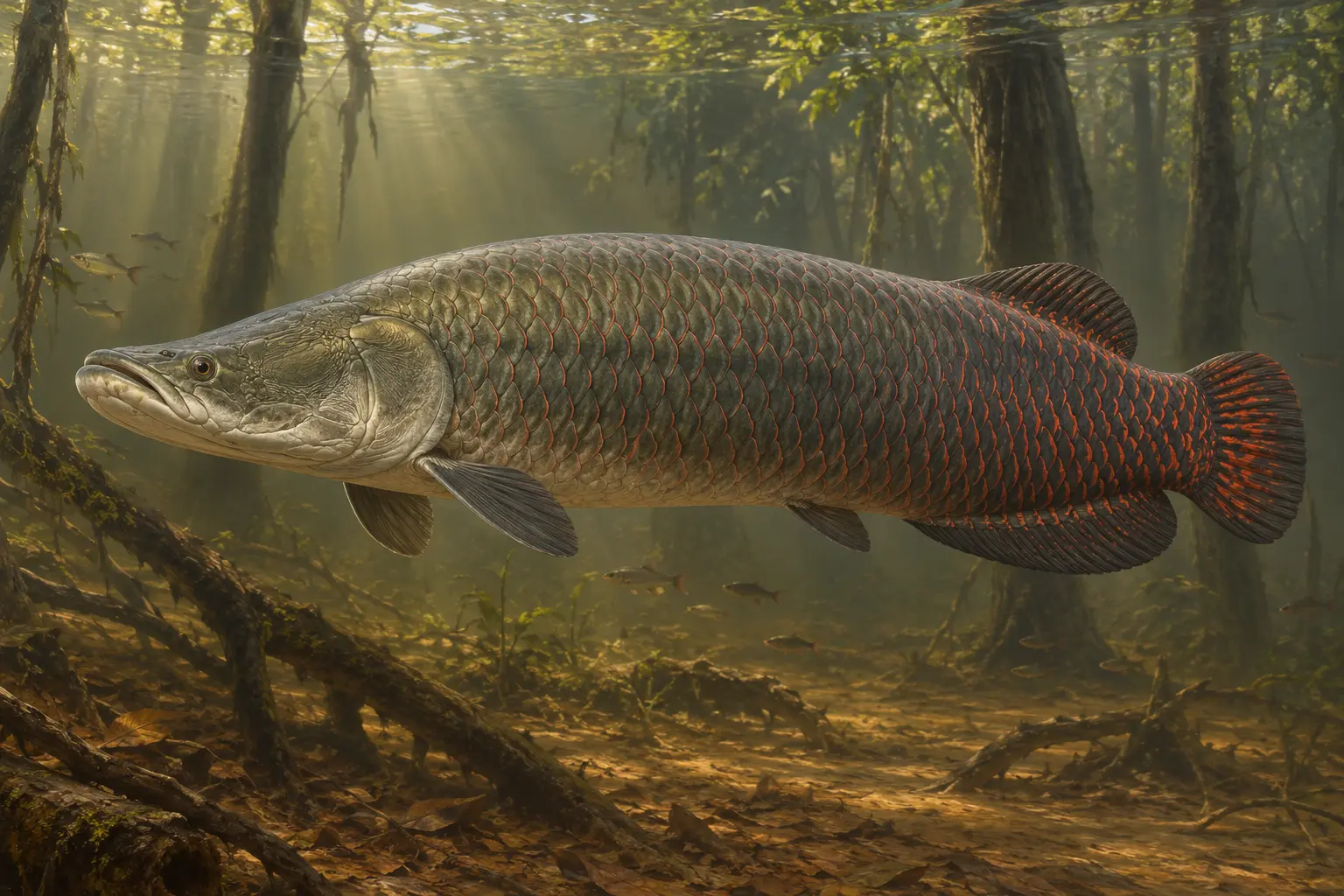
Native to tropical river systems and floodplains of the Amazon and Essequibo basins; oxbow lakes, slow channels and seasonally flooded forest with oxygen-poor water are important habitat. Populations outside the native region may be introduced. [1,2]
Large fish can approach 3 m and about 200 kg, although individuals around 2.2–2.4 m and roughly 90 kg are more typical in modern records. Historical maximum claims should be treated cautiously. [1]
A broad flattened head with a slightly upturned mouth, elongated body with very large scales, and dorsal and anal fins set close to the tail are characteristic. Adults often show stronger red or orange colour on the rear body and tail. [1]
A vascularised swim bladder functions as an air-breathing organ, enabling life in hypoxic water but revealing the fish when it surfaces. Multi-layered scales combine hard mineral and tough collagen components to resist puncture. [1]
Behaviour and ecology
It must surface periodically to gulp air, producing a conspicuous sound. Fish hunt near the surface, track rising and falling water, and use flooded habitat for feeding, growth and rearing young. [1]
Diet
Feeds mainly on fish, while also taking crustaceans, insects and small animals near the surface; fruits and seeds are also reported. The mouth generates rapid suction to engulf prey rather than prolonged biting. [1]
Reproduction and life cycle
Breeding follows the flood cycle; pairs excavate a shallow bottom nest when water levels are suitable. Males guard early broods, whose young cluster near the father's head and surface more frequently than adults. [1]
Ecosystem role
A large predator in river–flooded-forest food webs, it also moves biomass and nutrients among seasonal habitats. Eggs and young still provide food for many other species. [1]
Threats & conservation
Overfishing, targeting fish at the surface, floodplain degradation and gaps in taxonomy and population data are major risks. Appendix II requires appropriate documentation; monitored community management with local quotas can support recovery. [1–4]
Reviewed 22 September 2026: IUCN still displays DD for Arapaima gigas; DD means insufficient assessment data, not low risk. The species is in CITES Appendix II; taxonomy within Arapaima remains complex, so identification and source locality must be explicit.5 sourced facts
Species in five facts
Arapaima are obligate air breathers and cannot rely on gills alone. [1]
The dorsal and anal fins sit close to the tail, supporting short bursts of propulsion. [1]
Males guard the brood during the early period after hatching. [1]
Scales combine a hard mineral exterior with tough collagen architecture beneath. [1]
IUCN's DD category denotes inadequate data, not evidence that populations are secure. [3]
Sources
[1] Smithsonian's National Zoo — Arapaima[2] FishBase — Arapaima gigas[3] IUCN Red List species search[4] CITES Appendices effective 5 March 2026