
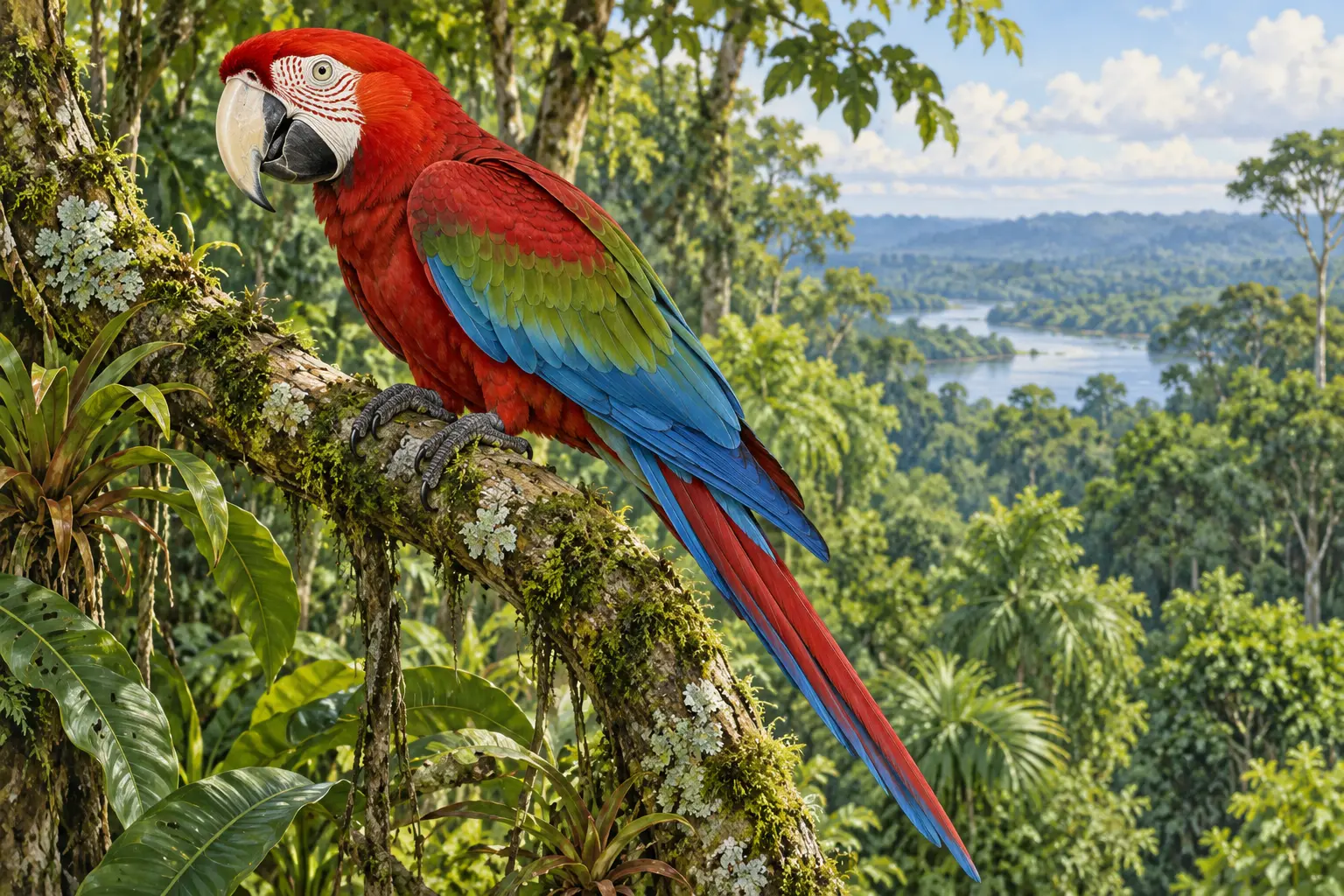
Widely but unevenly distributed across tropical South America, from Amazonia and the Guianas to the Pantanal and southern regions. It uses humid forest, gallery forest, woodland, wooded savanna and sometimes mangroves where food trees and large nest cavities remain. [1,2]
About 65–92.5 cm long, with a wingspan near 102–122.5 cm and mass around 1.25–1.7 kg in the SeaWorld synthesis. The tail contributes much of the length; these are population ranges, not targets for every bird. [1]
The head, breast and body are red; middle wing coverts are green and flight feathers plus upper tail are blue. Fine red feather lines cross the white face, and the massive pale upper bill meets a black lower bill; unlike the scarlet macaw it lacks a broad yellow wing band. [1]
The deep hooked bill generates force for hard foods and serves as a 'third foot' in climbing. Two-forward, two-back toes hold items, while the long tail and broad wings support controlled flight across forest gaps. [1]
Behaviour and ecology
Usually encountered in pairs or small groups moving among roosts, feeding trees, mineral sites and nest cavities. Long pair bonds and loud calls maintain contact through the canopy, while the bill and zygodactyl feet work together for climbing and food handling. [1]
Diet
Feeds seasonally on seeds, fruit, nuts, berries, leaves and other plant material, and may visit clay or mineral-rich ground. In care, a varied whole-food diet with foraging opportunities is preferable to a monotonous fatty-seed ration. [1]
Reproduction and life cycle
It nests in tree cavities and may lay up to three eggs; incubation is about 28 days and young fledge around 90–100 days in the SeaWorld synthesis. Juveniles continue learning from parents after flight, so early separation can remove an important social-development stage. [1]
Ecosystem role
Macaws both destroy seeds and drop or move fruit and seeds among trees, sometimes making food available to other animals. Dependence on old cavity trees ties population health to mature-forest structure, not merely green canopy area. [1,2]
Threats & conservation
Loss of nest trees, forest conversion, hunting and trapping for trade drive declines at range margins, and the species has disappeared from parts of its historical range. Any acquisition requires legal captive-bred provenance, identification, health files, social-welfare planning and a multi-decade care commitment. [1–4]
Reviewed 27 September 2026: IUCN records LC in the 2016 assessment, with a decreasing population trend. CITES Appendix II controls international trade; LC does not exempt wild-sourced acquisition, transactions or transport from documentation.5 sourced facts
Species in five facts
The green middle-wing band separates it from the scarlet macaw's broad yellow band. [1]
Fine red feather lines cross the white facial patch. [1]
Wingspan can exceed 1.2 m in large individuals. [1]
A clutch may contain up to three eggs and incubates for about 28 days. [1]
CITES regulates international trade under Appendix II. [4]
Sources
[1] SeaWorld — Green-winged macaw[2] Animal Diversity Web — Ara chloropterus[3] IUCN Red List species search[4] CITES Appendices effective 5 March 2026