
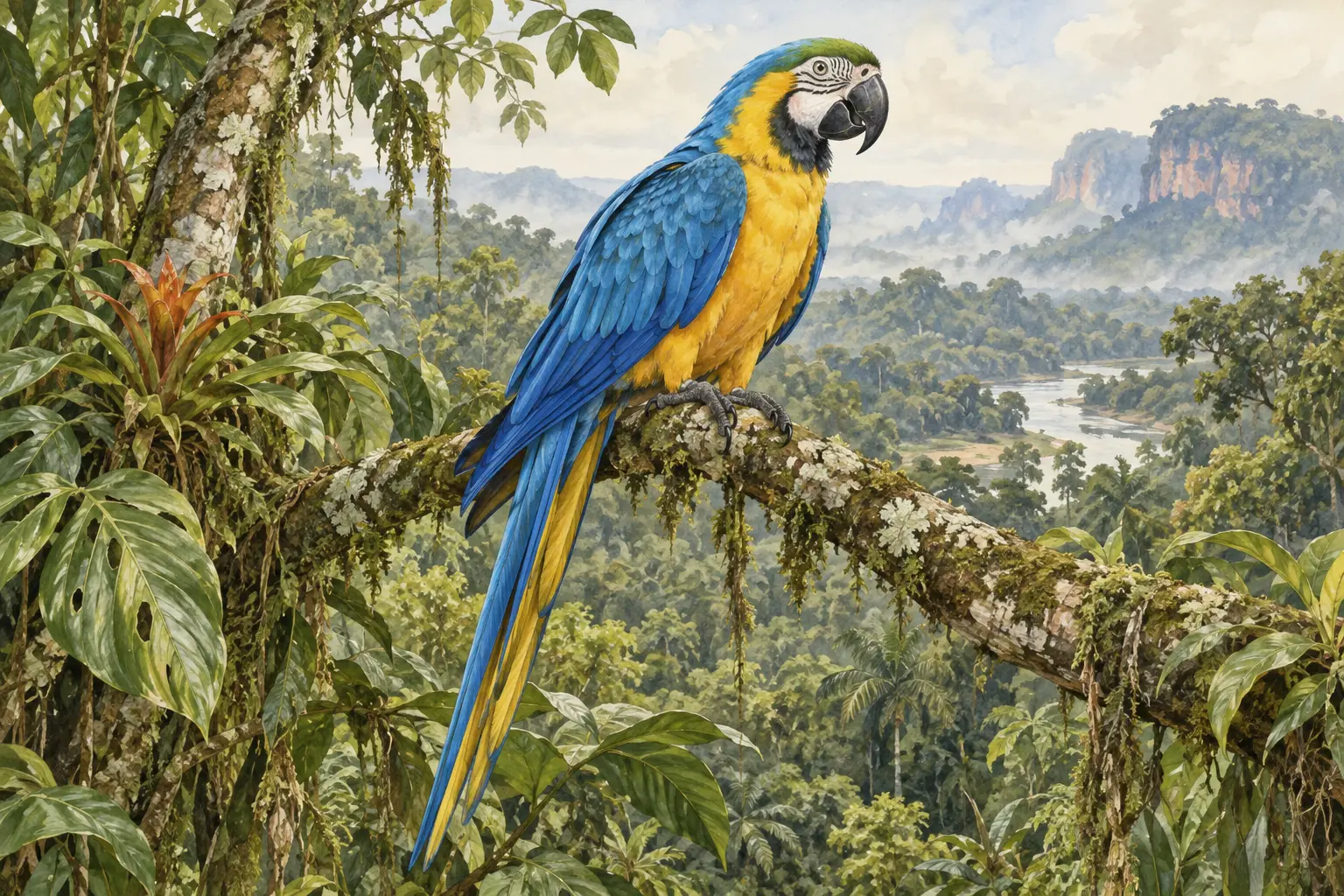
Tropical forests and wooded habitats in South America, often using the canopy. [1]
Approximately 81–91.5 cm long, including its long tail. [1]
Green forehead, black throat, and white facial skin crossed by dark feather lines. [1]
Its powerful bill opens hard foods and acts as a third support when climbing. [2]
Behaviour and ecology
Active by day; pairs commonly fly within flocks and communicate with loud calls. [1,2]
Diet
Fruit, seeds and nuts, with other plant material in its natural diet. [2]
Reproduction and life cycle
Nests in tree cavities, laying small clutches; incubation lasts about four weeks and chicks depend on parents. [1,2]
Ecosystem role
Interacts with plants through fruit and seed feeding; not every consumed seed is dispersed. [1; ecological interpretation]
Threats & conservation
Habitat loss and collection require locality-specific attention. The current IUCN assessment was not directly verified in this review. [1]
Reviewed 16 September 2026: direct CITES sources were inaccessible; no Appendix or trade entitlement is inferred. IUCN labels identify indexed or secondary sources; the full current assessment was not confirmed. Recheck before legal decisions.5 sourced facts
Species in five facts
The long tail contributes substantially to total length. [1]
The bill supports both feeding and climbing. [2]
The sexes have similar coloration. [1]
Newly hatched chicks require parental care. [1]
Oregon Zoo reports a lifespan reaching 50 years. [2]
Sources
[1] Animal Diversity Web — Ara ararauna[2] Oregon Zoo — blue-and-gold macaw