
South and Southeast Asia from India through mainland Southeast Asia to southern China, the Malay Peninsula, Sumatra, Java and Borneo, using rivers, marshes, mangroves and rice fields.
Head-body length is roughly 40–61 cm with a 25–35 cm tail; mass is commonly 2.7–5.4 kg, distinctly smaller than most other otters.
Dark brown coat with a paler face and throat, rounded head and long sensory whiskers. Webbing is reduced and the claws do not project beyond the fingertips.
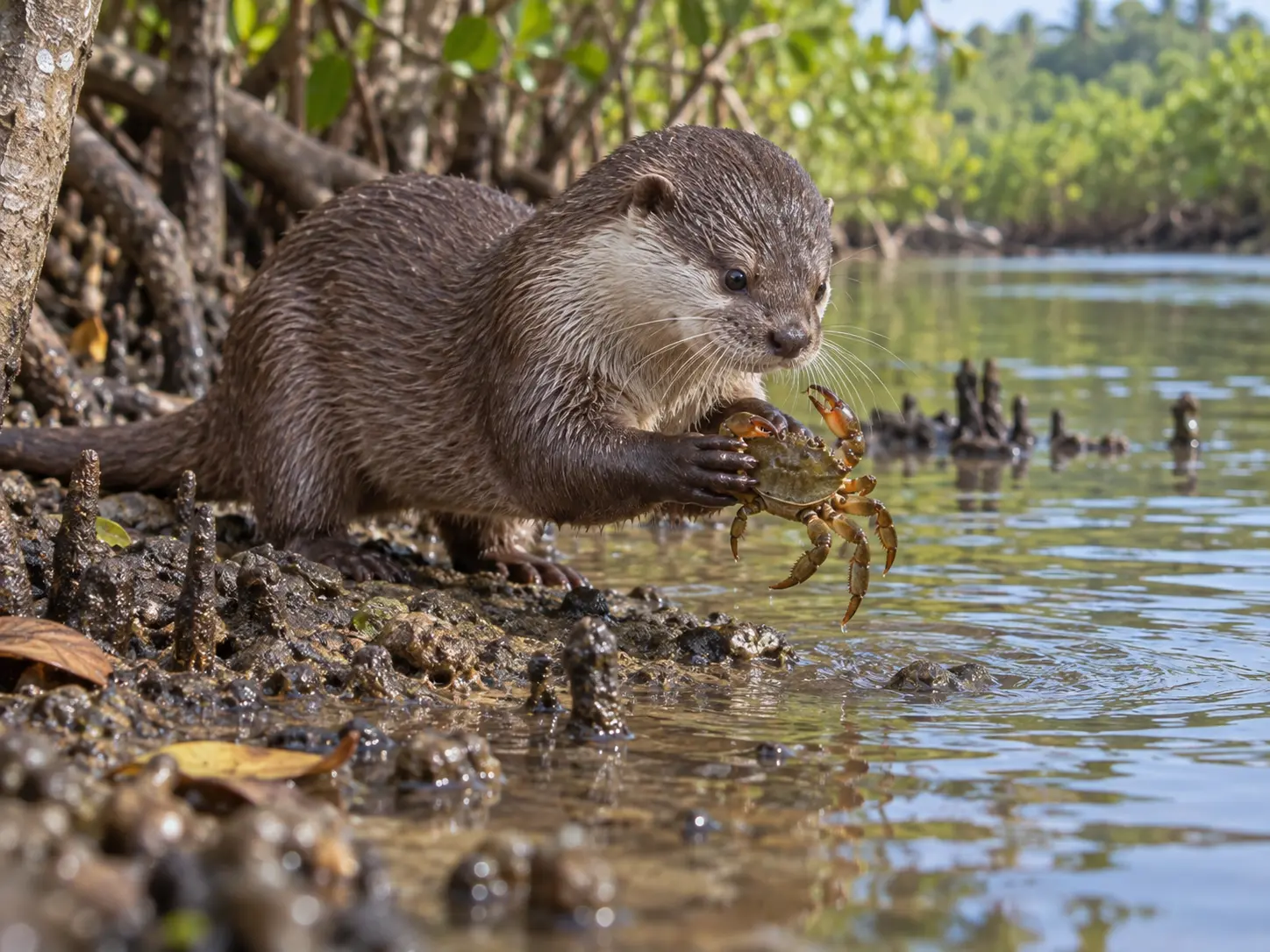
Dexterous digits and vibrissae locate prey in turbid water; broad rear teeth crush shells, while a streamlined body and strong tail support swimming.
Behaviour and ecology
Lives in family groups and communicates through varied calls, scent and touch. Sensitive forepaws probe mud, turn stones and manipulate prey.
Diet
Favours crabs, snails, bivalves and other aquatic invertebrates, also taking fish, frogs and other small prey depending on habitat.
Reproduction and life cycle
Breeding pairs may maintain long bonds; gestation is about two months and group members help care for pups in a holt near water.
Ecosystem role
Predates benthic fauna and helps regulate crabs and molluscs; it is a useful wetland-quality indicator but may conflict with aquaculture ponds.
Threats & conservation
IUCN lists it as VU owing to wetland loss, pollution, prey decline, conflict and pet trade. Since 2019 it has been in CITES Appendix I, placing strict limits on international commercial trade.
IUCN/CITES status was checked on the profile date; re-verify before any legal or transaction decision.5 sourced facts
Species in five facts
It is the smallest otter species.
Its reduced claws give the species its common name.
Forepaws are central to locating many prey items.
Family groups use a rich vocal repertoire.
The move to CITES I responded to international pet-trade pressure.
Sources
Smithsonian National ZooIUCN Otter Specialist GroupIUCN Red List searchCITES Checklist