
Remaining populations are fragmented across the Indian subcontinent, South-East Asia and northern Australia. The species uses marshes, wet grasslands, flooded rice fields and adjacent farmland; the South-East Asian population has declined especially severely. [1,2]
Standing height is about 1.76–1.8 m, mass commonly 5–12 kg and wingspan may approach 2.5 m. Males are typically larger, while plumage is similar between sexes. [1,3]
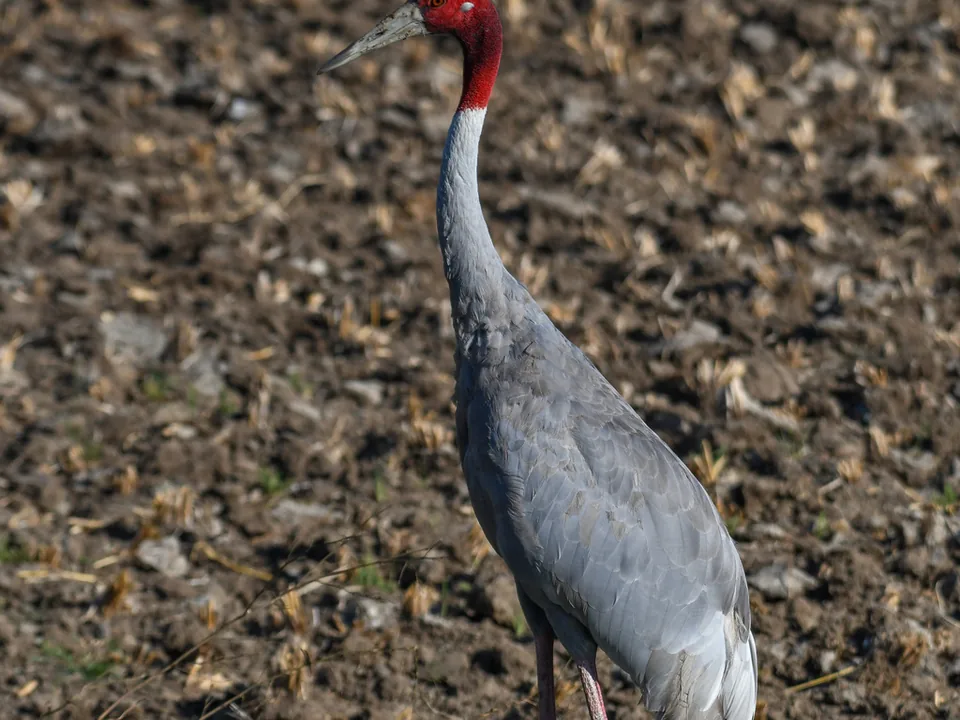
Adults have a pale grey body, red legs and largely bare red head and upper neck with a small grey ear patch. Juveniles are cinnamon-brown and lack the strongly developed adult red head pattern. [1,3]
Long legs permit wading in deeper water than many field birds, while the long neck and bill extend foraging reach. An elongated trachea coiled in the sternum helps produce far-carrying calls across open landscapes. [1,3]
Behaviour and ecology
Breeding pairs defend territories and perform unison calls and dances; outside breeding they may flock at large wetlands. Many populations are largely resident but move with water levels and food availability. [1,3]
Diet
Omnivorous, taking aquatic plants, tubers, seeds and grain, insects, other invertebrates, fish, frogs and small vertebrates. It forages by probing mud, shallow water and fields. [1,3]
Reproduction and life cycle
Breeding usually coincides with the rains; pairs build large grass-and-reed nests in wetlands. Clutches are commonly 1–3 eggs, incubation about 28–31 days, and both parents care for young through fledging. [3]
Ecosystem role
Sarus cranes consume plants and prey on small animals, linking trophic levels in wetlands and rice landscapes. The species also serves as an indicator and conservation flagship for South-East Asian wetlands. [1; ecological interpretation]
Threats & conservation
Wetland conversion and water diversion, chemical poisoning, nest disturbance, power-line collision, invasive species and changing agriculture are major pressures. Conservation must link wetland protection with community livelihoods and safer farming. [1,2]
Reviewed 21 September 2026: the International Crane Foundation records IUCN VU and CITES Appendix II. CITES may display the older name Grus antigone; this profile uses current Antigone antigone and notes the synonym in its sources.5 sourced facts
Species in five facts
At nearly 1.8 m tall, it is the tallest flying bird. [3]
Pairs perform unison calls that reinforce bonds and advertise territory. [1]
The eastern subspecies occurs in Laos, Viet Nam and Cambodia. [1]
The nest may resemble a grassy island in shallow water. [3]
Juveniles wear cinnamon-brown plumage rather than the adult red head-and-neck pattern. [1]
Sources
[1] International Crane Foundation — Sarus Crane[2] BirdLife DataZone — Sarus Crane[3] Animal Diversity Web — Grus antigone (synonym)[4] CITES Appendices effective 5 March 2026[Ảnh] iNaturalist observation 241610721 — Rejoice Gassah, CC BY