
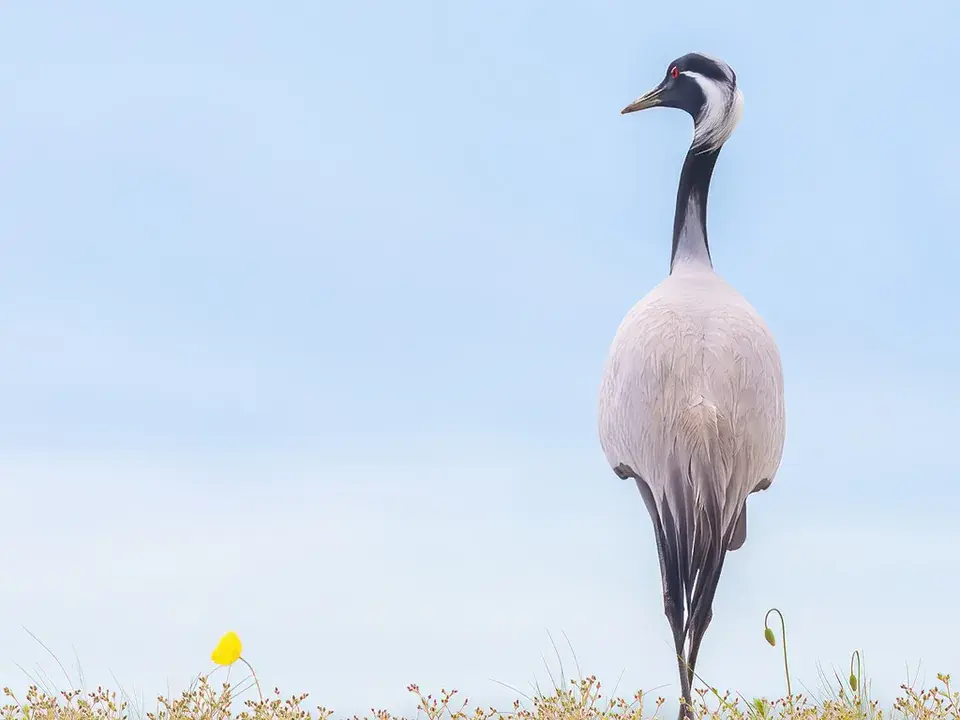
Breeding populations extend from the Black Sea region and Central Asia to Mongolia and northeastern China, with wintering areas in northeastern Africa and South Asia. It favours grassland, semi-arid steppe, savanna, plateaus and open farmland, usually remaining near water. [1,2]
The International Crane Foundation gives a height near 89 cm, while ADW reports average adult length around 90 cm. Sources use standing height or body length, so these measurements should not be treated as identical. [1,2]
A slender grey body, black fore-neck and breast, black legs and red eye, with a white plume extending behind the eye. Unlike many cranes with bare red crown skin, the head is feathered; the relatively short bill and toes suit dry upland foraging. [2]
Shorter legs and toes than many wetland cranes aid running and foraging on grassland, while long wings support migration. Some flocks cross the Himalayas at great altitude, but this is route-specific behaviour rather than a constant flight level for every population. [2,3]
Behaviour and ecology
Pairs occupy breeding grounds, while flocks assemble during migration and winter. Partners use unison calls and dances of bows, leaps, runs, short flights and tossed objects to reinforce bonds and defend territory. [2]
Diet
An opportunistic omnivore taking seeds, grains, leaves, fruit and other plant material alongside insects, worms, snails and occasional small vertebrates. Short bills and toes aid ground feeding in dry uplands, pasture and fields. [1,2]
Reproduction and life cycle
A sparse ground nest contains a few twigs and pebbles, with an average clutch of two eggs. Both parents incubate for 27–29 days; chicks are mobile early and fledge at about 55–60 days, remaining with their parents for months. [2]
Ecosystem role
Feeding on seeds and invertebrates links food webs across grassland, farmland and riparian areas, while eggs and chicks are prey. Migratory flocks move energy and nutrients among ecosystems along the Central Asian flyway. [1,2]
Threats & conservation
Threats include habitat loss, desertification, agricultural change, disturbance, dams and water diversion, hunting, trapping and poisoning. LC does not mean every population is secure; DinoJura should consider only animals with breeding evidence, consistent identification and complete CITES and veterinary records. [1,4,5]
BirdLife lists the species as Least Concern (LC); Gruidae spp. are in CITES Appendix II except taxa listed in Appendix I. Many current lists use Grus virgo, while BirdLife, ADW and the DinoJura catalogue asset use Anthropoides virgo; this profile retains the latter and flags the synonym to prevent document mismatches. [1–5]5 sourced facts
Species in five facts
It is the smallest of the 15 living crane species. [1,3]
Standing height is reported at about 89 cm. [1]
The average clutch contains two eggs. [2]
Incubation lasts about 27–29 days. [2]
Young fledge after roughly 55–60 days. [2]
Sources
[1] International Crane Foundation — Demoiselle Crane[2] Animal Diversity Web — Anthropoides virgo[3] International Crane Foundation — Crane migration[4] BirdLife DataZone — taxonomy and Red List data[5] CITES Appendices effective 5 March 2026Photo record — egorbirder / iNaturalist