
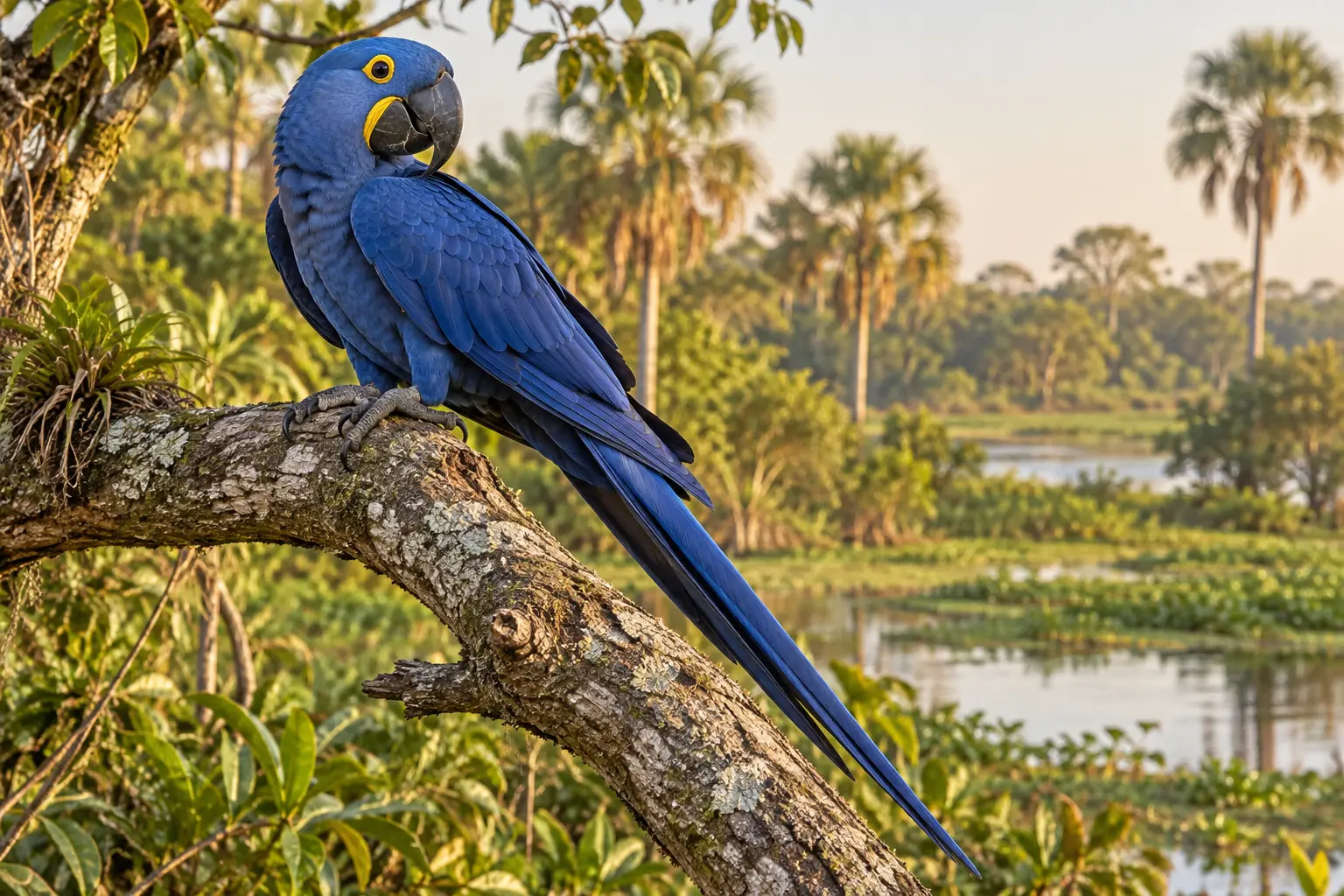
Occurs in separated regions of Brazil, Bolivia and Paraguay, including the Pantanal, Cerrado and southern-eastern Amazon basin. It uses palm woodland, wooded savanna, gallery forest and patches containing nest trees. [1,2]
About 1 m from head to tail tip and commonly around 1.2–1.7 kg. Much of the length is the pointed tail; it is the longest parrot, though the flightless kakapo may be heavier. [2]
Deep blue throughout with a long tail and a deep, powerful black bill; yellow skin forms a narrow eye-ring and strip at the lower mandible base. It lacks a large yellow cheek patch; the smaller Lear's macaw has differently shaped yellow skin. [1,2]
The bill generates high force to open palm nuts; a muscular tongue positions food and two-forward, two-back feet hold it. The long tail and broad wings support travel among widely separated resources. [2]
Behaviour and ecology
Often seen in pairs, family parties or small flocks moving between roosts, food trees and nests. Pair bonds are long-lasting, and loud calls maintain contact in open habitat and flight. [1,2]
Diet
Specialised on hard palm nuts cracked with the massive bill, with other fruit and seeds also taken. In the Pantanal, livestock may drop or process fruit pulp and make nuts accessible, but this is a context-dependent interaction. [2]
Reproduction and life cycle
Nests in large tree cavities or cliffs depending on region, commonly laying two eggs although two young are not always raised. Manduvi trees provide important Pantanal cavities, making old-tree protection directly relevant. [1,2]
Ecosystem role
A powerful seed predator that also transports and drops fruits and nuts, it redistributes plant material and leaves food fragments for other animals. Vacated nest cavities may later be used by other cavity-dependent species. [1,2]
Threats & conservation
Habitat loss, fire, shortage of nest trees and historical trapping have driven decline. Managed programmes need compatible social partners, flight space, safe destructible materials, veterinary-reviewed diets and closed-loop records for every individual. [1–4]
Reviewed 25 September 2026: BirdLife/IUCN records VU; CITES Appendix I strictly limits international commercial trade in wild specimens. Captive-bred status does not replace permits, identification and a continuous chain of origin records.5 sourced facts
Species in five facts
It is the longest flying parrot, approaching 1 m including the tail. [2]
Its bill can open exceptionally hard palm nuts. [2]
Yellow bare skin surrounds the eye and lines the lower mandible base. [1,2]
Pairs commonly maintain long-term bonds. [2]
Old cavity trees are a limited breeding resource that recovers slowly. [1]
Sources
[1] BirdLife DataZone — Hyacinth Macaw[2] Animal Diversity Web — Anodorhynchus hyacinthinus[3] IUCN Red List species search[4] CITES Appendices effective 5 March 2026