
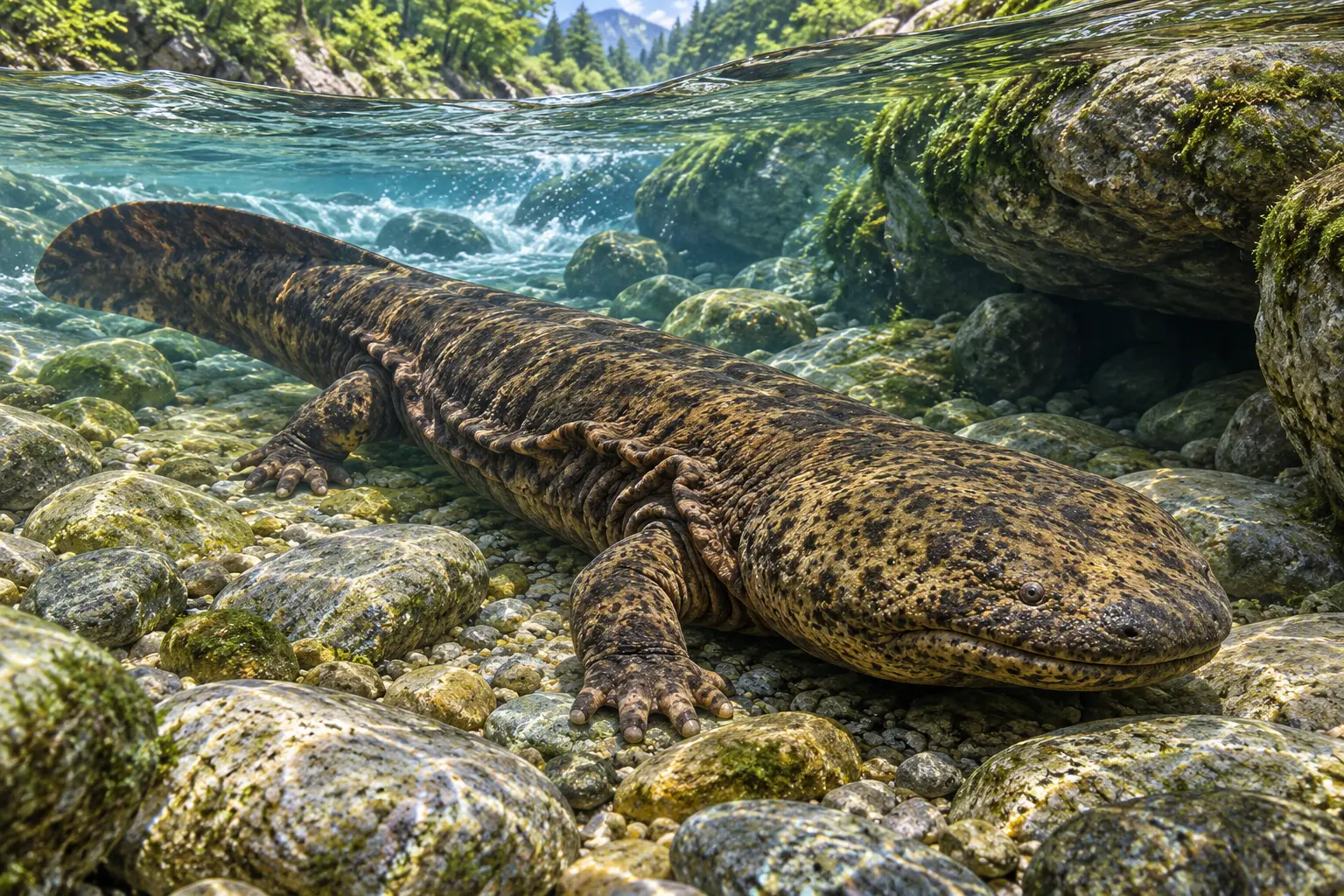
Historically widespread in central, southern and south-western Chinese drainages, mainly fast-flowing mountain rivers and streams with vegetated banks and underwater rock cavities. Many current records may involve released farm animals, so locality alone does not prove a native population. [1,3]
Modern individuals average around 1 m and 11 kg, while historical records reach 1.8 m. The head and body are broad and flat, and the laterally compressed tail contributes much of the length; growth continues after maturity, but extreme sizes are now rare. [1]
The head is extremely broad with a large curved mouth, tiny lidless eyes and mottled brown-olive skin folded along the flanks. Limbs are short, forefeet have four toes and hind feet five, and adults lack external gills. External appearance cannot reliably distinguish Andrias lineages without genetic evidence. [1,3]
Deep skin folds increase respiratory surface in oxygen-rich water, the flat body hugs the bottom and the compressed tail powers swimming. Mottling camouflages among rocks, while vibration sensing and suction enable dark-water hunting. These traits also make the species vulnerable to low oxygen and siltation. [1]
Behaviour and ecology
Primarily nocturnal, solitary and territorial around bottom refuges. Weak vision is offset by vibration sensing through nodes along the body; males prepare breeding dens and may fight intensely with intruders. [1]
Diet
An ambush predator of crabs, fish, frogs, insects, small aquatic mammals and sometimes conspecifics. Elastic jaw cartilage produces rapid asymmetric suction, drawing prey into the mouth without long pursuit in current. [1]
Reproduction and life cycle
Breeds around August–September. Females lay roughly 300–560 eggs in an underwater den; fertilisation is external, after which the male 'den master' guards them, tail-fans oxygenated water and removes failed eggs. Hatching takes about 40–60 days, and maturity occurs around 5–7 years. [1]
Ecosystem role
An apex predator in many stream reaches, it regulates crustaceans, insects, frogs and fish and signals cold, well-oxygenated water with intact rock structure. Its loss simplifies freshwater food webs and reflects broader catchment degradation. [1]
Threats & conservation
Harvest for food, dams and waterworks, pollution, siltation, river fragmentation, disease and genetic mixing from farm releases all create risk. Appendix I strictly restricts international commercial trade in wild specimens; rescue or release requires disease and genetic screening, never mass release from farms. [1–4]
Reviewed 26 September 2026: IUCN records CR from a 2004 assessment, so data age must remain visible. Genetic research shows that A. davidianus historically covered a complex of lineages or species; this account treats A. davidianus sensu stricto and does not pool every lineage. CITES lists the species in Appendix I.5 sourced facts
Species in five facts
Historical individuals have reached up to 1.8 m. [1]
Deeply folded skin contributes to underwater gas exchange. [1]
Males guard eggs and fan them with the tail to increase oxygenated flow. [1]
Eggs commonly hatch after about 40–60 days. [1]
A. davidianus was historically defined too broadly; lineage confirmation requires genetic data. [3]
Sources
[1] Animal Diversity Web — Andrias davidianus[2] IUCN Red List species search[3] Zoological Society of London — Chinese giant salamander conservation research[4] CITES Appendices effective 5 March 2026