
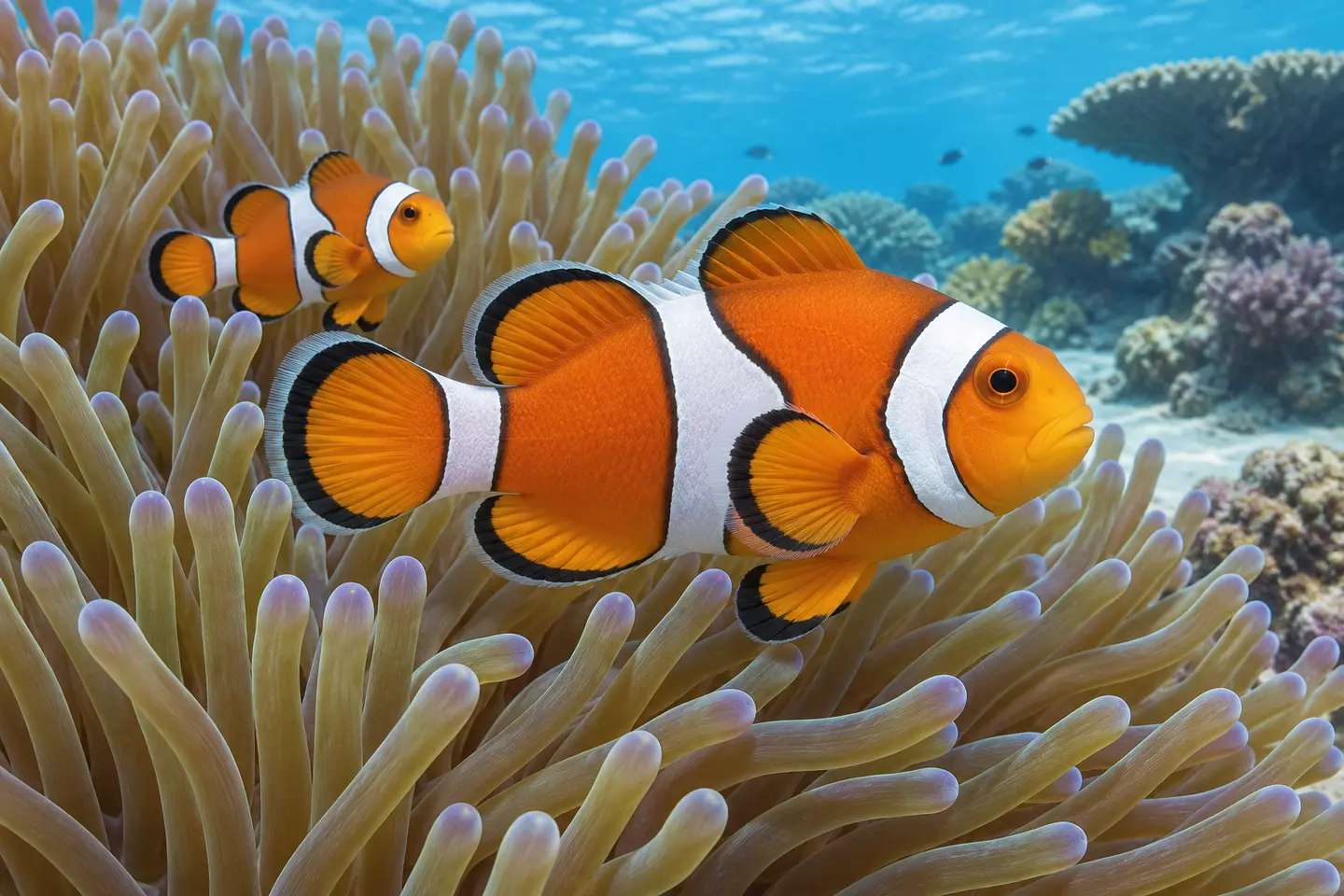
Occurs from the Andaman Sea and South-East Asia through the Philippines and Indonesia to north-western Australia; inhabits lagoons and coastal reefs with suitable host anemones, usually in shallow water. [1,2]
Maximum length is about 11 cm; the breeding female is largest, followed by the breeding male and smaller non-breeders. [1,2]
Orange with three vertical white bars edged narrowly in black: behind the eye, at mid-body and on the caudal peduncle. It usually has thinner black margins than the percula clownfish, but reliable identification also requires fin characters and locality. [1,2]
A specialised mucus coat and acclimation behaviour reduce host-anemone stinging. The association provides shelter, while clownfish defend, ventilate and deliver nutrients to the anemone. [2,3]
Behaviour and ecology
Lives in small groups within a host anemone under a strict size hierarchy. The largest fish is female; if she disappears, the breeding male changes sex and the next-ranked fish matures as male. [2,3]
Diet
Omnivorous, taking zooplankton, small crustaceans, algae and food particles, and may consume scraps from its host. Diet varies with size and microhabitat. [1,2]
Reproduction and life cycle
Lays adhesive eggs on hard substrate near the anemone. The male cleans, fans and guards the clutch; eggs commonly hatch at night after about 6–8 days depending on temperature, followed by a pelagic larval phase before settlement. [2,3]
Ecosystem role
It is part of a fish–anemone mutualism: swimming improves water exchange around the host, waste supplies nutrients and the fish deters some anemone predators. [2,3]
Threats & conservation
IUCN lists the species as LC, but reef degradation, heat-driven anemone bleaching and aquarium collection can create local pressure. Documented captive-bred supply can reduce wild dependence but still requires health and welfare controls. [2–4]
Reviewed 19 September 2026: the IUCN record lists LC. Amphiprion ocellaris was not found in the CITES Appendices effective 5 March 2026; this does not waive fisheries, quarantine, transport-welfare or exporting/importing-country rules.5 sourced facts
Species in five facts
Individuals begin as male-functioning or immature fish and may change to female according to rank. [2,3]
The breeding female is the largest fish in a stable group. [2,3]
The species bears three white bars on an orange ground colour. [1]
The male performs most egg fanning and guarding. [2]
Clownfish are not universally immune to every anemone; they associate with a specific host set. [2,3]
Sources
[1] FishBase — Amphiprion ocellaris[2] Aquarium of the Pacific — Ocellaris clownfish[3] Smithsonian Ocean — Clownfish and anemones[4] IUCN Red List species search[5] CITES Checklist