
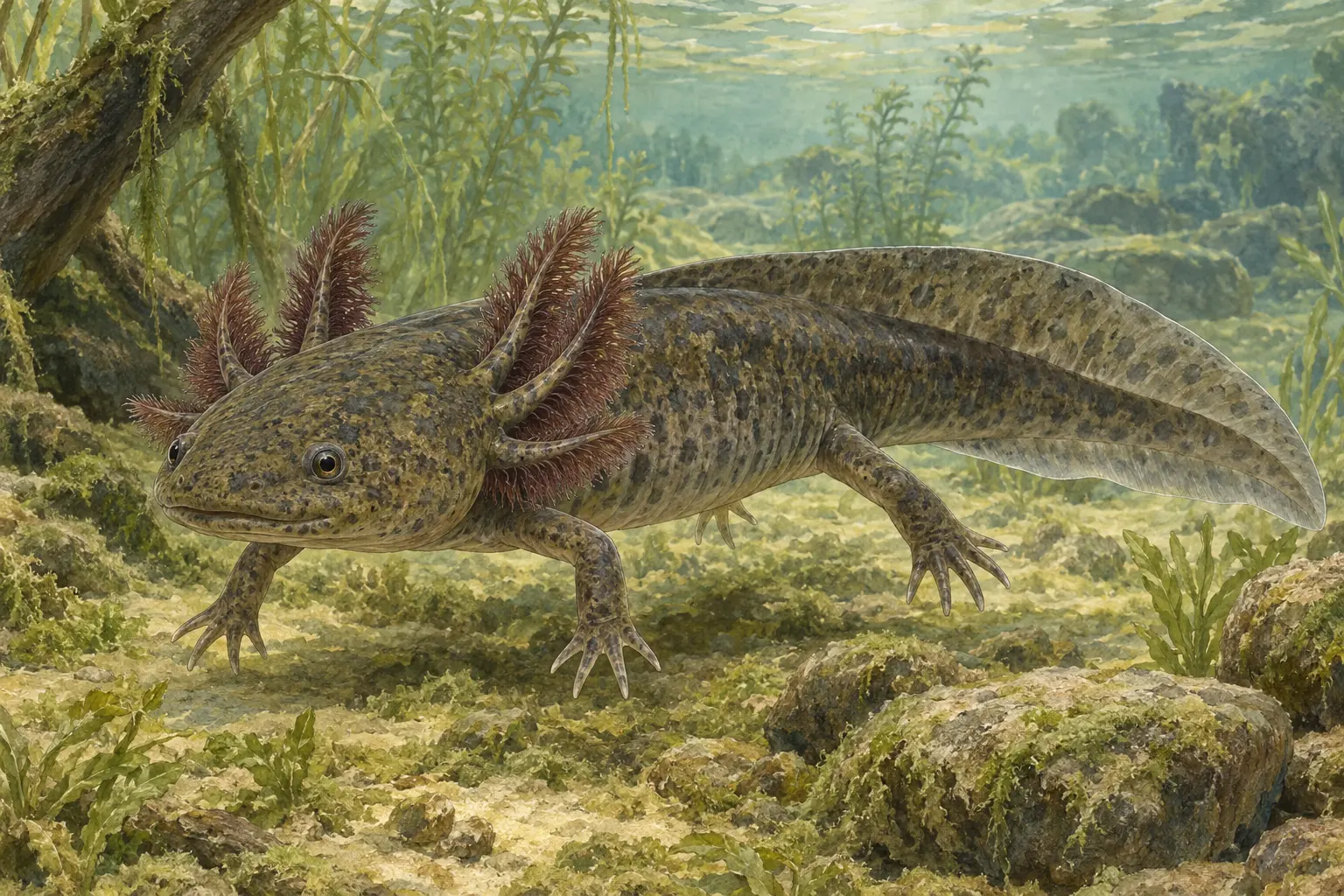
Native to the Xochimilco–Chalco lake system, now reduced to remnant canals and wetlands. [2]
Can reach approximately 30 cm in length. [2]
Wild forms are usually mottled brown-grey, with feathery external gills, four limbs and a flattened tail. [2]
Remains aquatic as an adult and can regenerate limbs; induced metamorphosis should not be attempted. [2]
Behaviour and ecology
Shelters in vegetation or mud by day and becomes more active at night. [1]
Diet
Suction-feeds on worms, insect larvae, crustaceans, molluscs and small fish. [1]
Reproduction and life cycle
Females receive a spermatophore and attach individual eggs to surfaces; young receive no parental care. [1]
Ecosystem role
A predator within its native freshwater food web. [2]
Threats & conservation
San Diego Zoo reports CR: pollution, habitat loss and introduced fish are major threats. Abundant captive animals do not replace habitat conservation. [1,2]
Reviewed 16 September 2026: direct CITES sources were inaccessible; no Appendix or trade entitlement is inferred. IUCN labels identify indexed or secondary sources; the full current assessment was not confirmed. Recheck before legal decisions.5 sourced facts
Species in five facts
Axolotls are amphibians, not fish. [3]
External gills persist into adulthood. [2]
Pink-white captive forms are not the typical wild coloration. [2]
Females deposit eggs individually. [1]
They can regenerate limbs. [2]
Sources
[1] San Diego Zoo — axolotl[2] Natural History Museum — axolotl biology[3] Animal Diversity Web — classification