
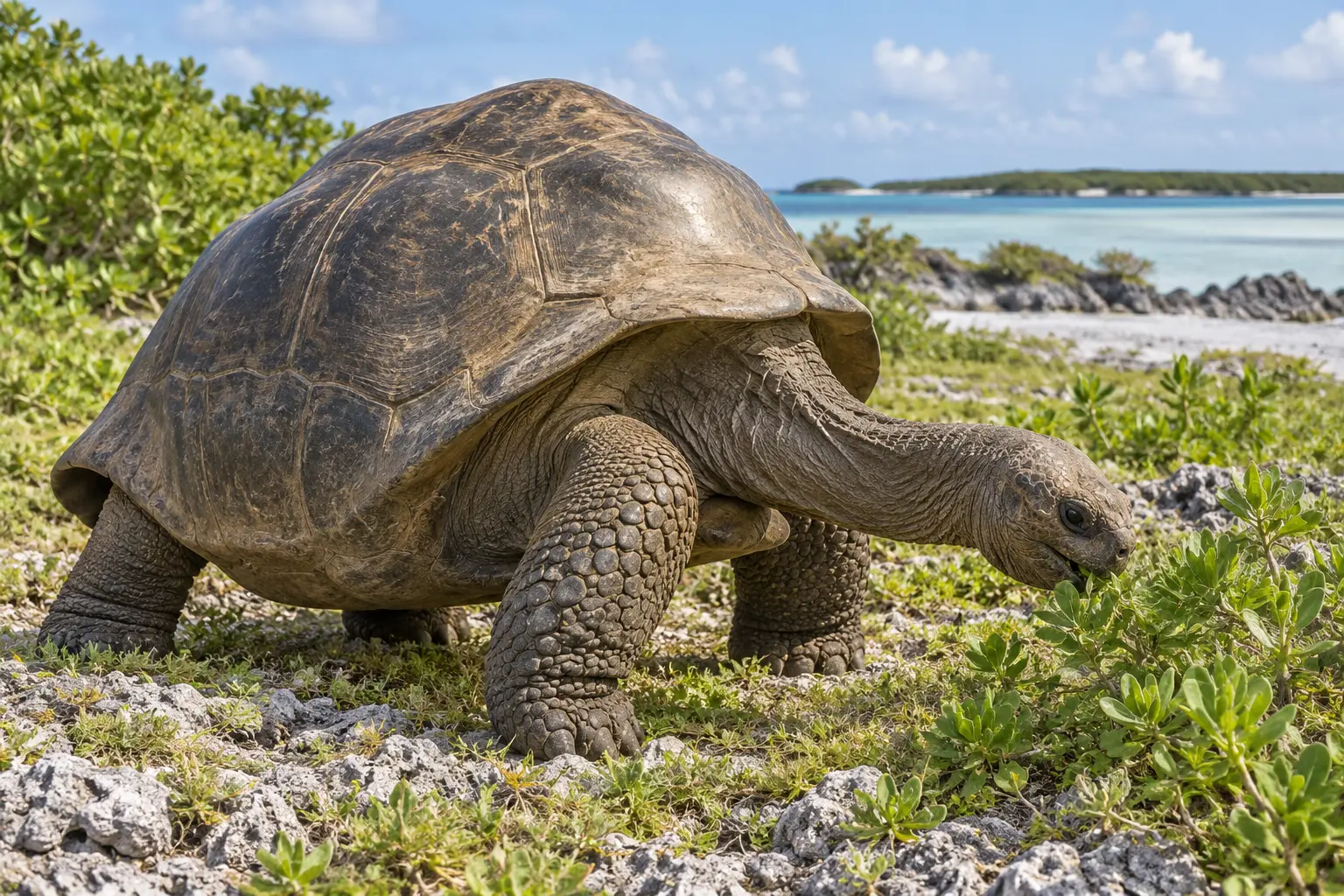
The principal native population occurs on Aldabra Atoll, with introduced populations on several other islands. On Aldabra it uses short grassland, scrub, coastal dunes and areas near mangroves, concentrating strongly on grasslands known as platins. [1,2]
Large males may have a carapace about 1.22 m long and weigh around 250 kg; females are usually smaller, around 0.91 m and up to 159 kg in Smithsonian records. These are upper values, not sizes for every individual. [1]
The thick high-domed carapace is dark grey to brown, with a relatively small head, long neck and cylindrical hind legs covered in large scales. A small nuchal scute is usually present; males have thicker tails and a more concave plastron. [1]
A long neck expands browsing height, and columnar legs distribute a very large body's load. Tolerance of temporary food and water shortage suits a seasonally dry island, but does not justify restricting water in managed care. [1]
Behaviour and ecology
Activity and rest vary with temperature; tortoises use shade, rock cavities, mud wallows or shallow water for thermoregulation. Despite slow movement, individuals follow feeding routes and aggregate at grassland, water and suitable refuges. [1]
Diet
It mainly grazes grasses and browses leaves, low branches and other fibrous vegetation, with occasional opportunistic foods. Managed diets should emphasise fibrous grasses and browse rather than sweet fruit and excessive energy. [1]
Reproduction and life cycle
Females excavate soil nests and lay about 9–25 eggs in the Smithsonian synthesis; clutch output varies with density and conditions. Incubation is roughly four months, while hatchlings face weather and introduced-predator risks. [1]
Ecosystem role
Tortoises consume large amounts of vegetation, push over small shrubs, create trails and transport seeds through the gut. UNESCO recognises Aldabra as holding the world's largest giant-tortoise population; their effect resembles that of large continental herbivores. [1,2]
Threats & conservation
Historically overharvested, the species now faces introduced species, disease, fire and climate risks on low islands. Managed individuals require large outdoor space, heat and shade choices, load-bearing substrates, provenance records and care planning that outlasts generations of keepers. [1–4]
Reviewed 25 September 2026: IUCN still displays VU from a 1996 assessment, so the category must be read with that data-age limitation. The current CITES Appendices list the species in Appendix II; individual origin and relevant permits remain necessary.5 sourced facts
Species in five facts
Large males can weigh about a quarter of a tonne. [1]
A small nuchal scute is usually visible at the front of the shell. [1]
Individuals can live beyond 100 years, but extreme ages require long-term records to verify. [1]
Seeds pass through the digestive tract and are dispersed into habitat. [1]
Aldabra holds the world's largest natural giant-tortoise population. [2]
Sources
[1] Smithsonian's National Zoo — Aldabra tortoise[2] UNESCO World Heritage Centre — Aldabra Atoll[3] IUCN Red List — Aldabrachelys gigantea (1996 assessment)[4] CITES Appendices effective 5 March 2026