
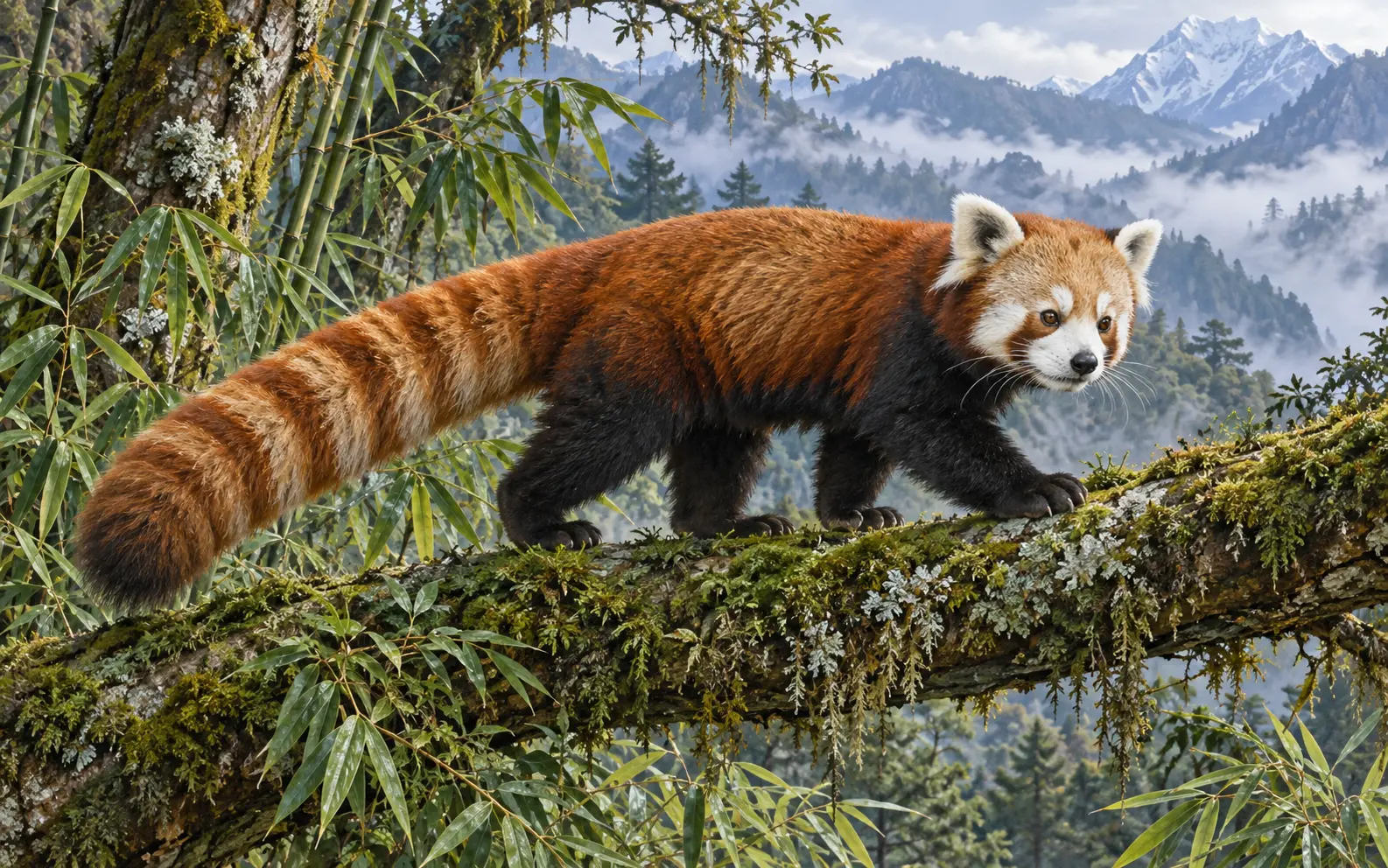
Patchily distributed in cool montane forests with bamboo from Nepal, Bhutan and north-eastern India through Myanmar to China, often at high elevation. Canopy, hollow trees, fallen logs, water and continuous bamboo form one connected habitat system. [1,2]
Body length is about 56–62.5 cm, the tail about 37–47.2 cm, and mass commonly 3.6–7.7 kg. The tail enlarges the silhouette but is not prehensile like that of many primates. [1]
Rufous upperparts, dark belly and legs, white-edged ears, white-brown facial markings and a thick ringed tail are characteristic. Facial patterns vary individually; colour or a single photograph cannot establish subspecies, provenance or kinship. [1]
An enlarged wrist bone forms a 'false thumb' for holding bamboo, while flexible ankles and semi-retractile claws grip bark. The thick tail aids balance and can wrap around the body for warmth while resting. [1]
Behaviour and ecology
Usually solitary and most active around dawn and dusk, it rests curled on branches or in tree cavities. Scent glands, urine and rubbing mark space, while furred feet and flexible ankles aid movement, including descending head-first. [1]
Diet
Bamboo makes up about 95% of the diet according to Smithsonian, supplemented opportunistically by fruit, roots, insects, eggs and small animals. Because bamboo digestion is inefficient, red pandas select high-quality leaves and shoots, feed for hours and conserve energy. [1]
Reproduction and life cycle
Breeding usually occurs from January to March; gestation is reported at about 93–156 days because implantation may be delayed. Females line a cavity nest with twigs, grass and leaves and produce a small litter whose cubs depend on the mother for their first months. [1]
Ecosystem role
Red pandas use both bamboo understorey and canopy, linking energy among plants, invertebrates and predators. As an indicator of cool montane bamboo forest, protecting their habitat also secures watersheds and corridors for many other species. [1,2]
Threats & conservation
Forest loss and fragmentation, bamboo decline, free-ranging dogs and canine distemper, trapping and trade are major pressures. Ex situ management needs pedigrees, avoidance of mixing unresolved taxonomic units and disease control at the human-dog-wildlife interface. [1–3]
Reviewed 28 September 2026: IUCN lists Ailurus fulgens as Endangered (EN) in its 2015 assessment, and CITES includes it in Appendix I. Some genetic studies propose separate Himalayan and Chinese species; this profile uses A. fulgens under current conservation-source treatment and requires population provenance to be retained.5 sourced facts
Species in five facts
The red panda is the only living member of Ailuridae. [1]
Bamboo accounts for about 95% of the diet reported by Smithsonian. [1]
An enlarged wrist bone functions as a false thumb. [1]
Flexible ankles allow head-first descent from trees. [1]
CITES regulates the species under Appendix I. [3]
Sources
[1] Smithsonian's National Zoo — Red panda[2] IUCN Red List species search[3] CITES Appendices effective 5 March 2026