
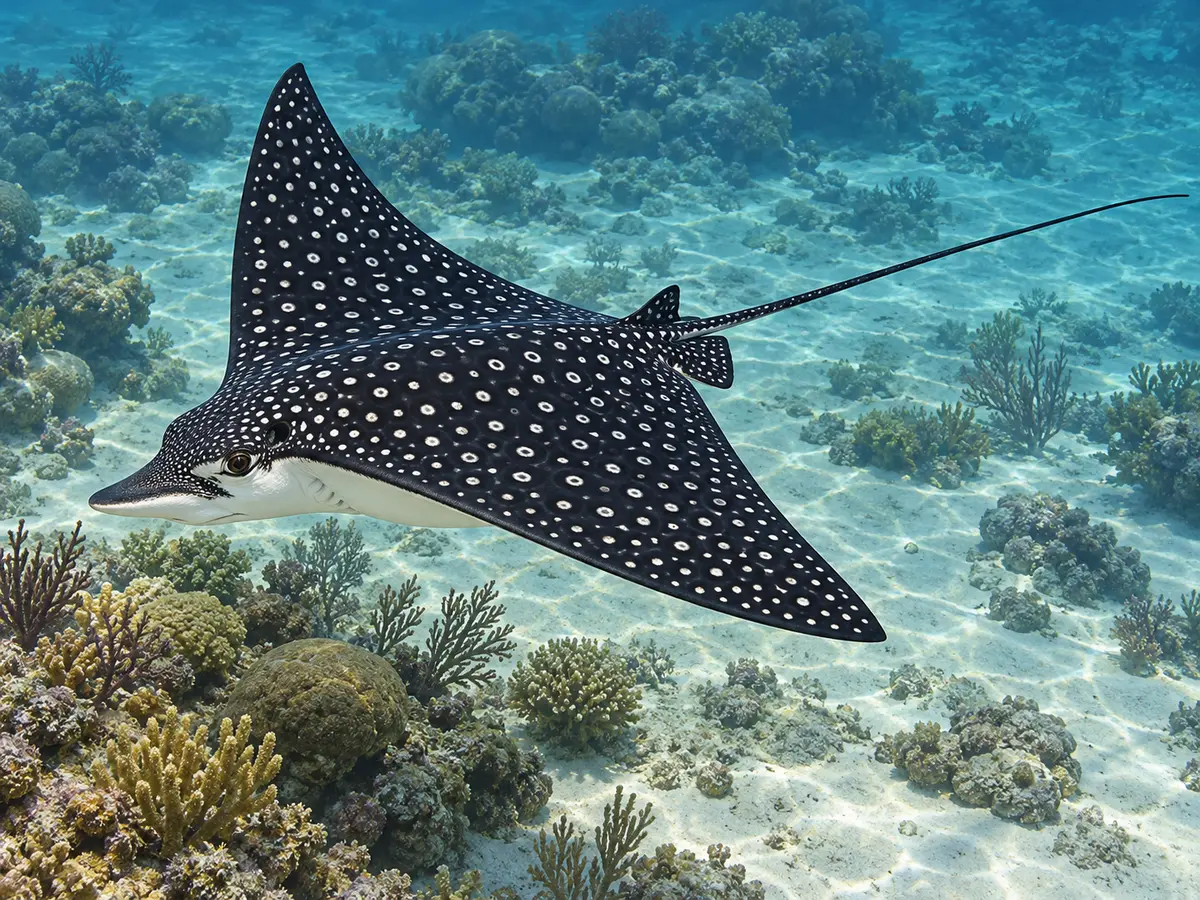
Under the current split, A. narinari occupies tropical-subtropical Atlantic waters, including the Caribbean and both Atlantic shores. It uses bays, estuaries, seagrass, reefs and offshore water to about 60 m; older extra-Atlantic records require taxonomic review. [1,2]
Florida Museum reports maxima near 3 m disc width, about 230 kg and total length approaching 5 m with an intact tail. These are published maxima, not typical dimensions. [1]
A broad disc has pointed wing tips, a projecting head and flattened snout; the blue-grey to black back bears white spots or rings and the underside is white. The whip-like tail bears spines; never handle, pull or identify the species by spots alone. [1]
Large pectoral fins generate lift and manoeuvrability; electroreceptors in the snout help find buried prey, while dental plates withstand shell crushing. Spiracles behind the eyes draw water in while the mouth probes the bottom. [1]
Behaviour and ecology
Swims by flapping the pectoral fins like wings, may travel singly or in groups and sometimes leaps clear of the water. Tracking studies show site fidelity in some areas, not a rule for every population. [1,3]
Diet
Takes clams, oysters, snails, crustaceans, sea urchins, squid and small fish, using the snout to excavate and flat dental plates to crush shells. Foraging disturbs sediment, making bottom quality important in managed design. [1]
Reproduction and life cycle
Aplacental viviparous: embryos use yolk and later receive uterine secretions. IUCN reports small litters of about 1–5 and gestation near one year; late maturity and low fecundity slow recovery. [2,3]
Ecosystem role
A predator of large molluscs and crustaceans, it also mixes sediment and creates feeding pits used by other organisms. Large sharks prey on eagle rays, linking benthic and water-column food webs. [1]
Threats & conservation
Targeted fishing, bycatch, coastal degradation and low reproductive output are major threats. EN does not mean every population declines equally, but it supports avoiding wild sourcing and prioritising bycatch reduction, estuary-reef protection and full traceability. [2,3]
IUCN assessed Aetobatus narinari as Endangered (EN) in 2021. The current species concept is mainly Atlantic; older sources combined Indo-Pacific populations now generally placed in A. ocellatus or A. laticeps. A. narinari was not located in the CITES Appendices effective 5 March 2026; that must not be interpreted as trade permission. [1–4]5 sourced facts
Species in five facts
The current concept separates Atlantic A. narinari from Indo-Pacific species. [1,2]
Flat dental plates crush mollusc and crustacean shells. [1]
Females produce a very small litter after a long gestation. [2]
The ray can leap completely out of the water. [1]
The very long tail is not the main propulsor; pectoral fins generate swimming force. [1]
Sources
[1] Florida Museum — Spotted eagle ray[2] IUCN Red List 2021 — Aetobatus narinari[3] Frontiers in Marine Science — age and growth[4] CITES Appendices effective 5 March 2026