
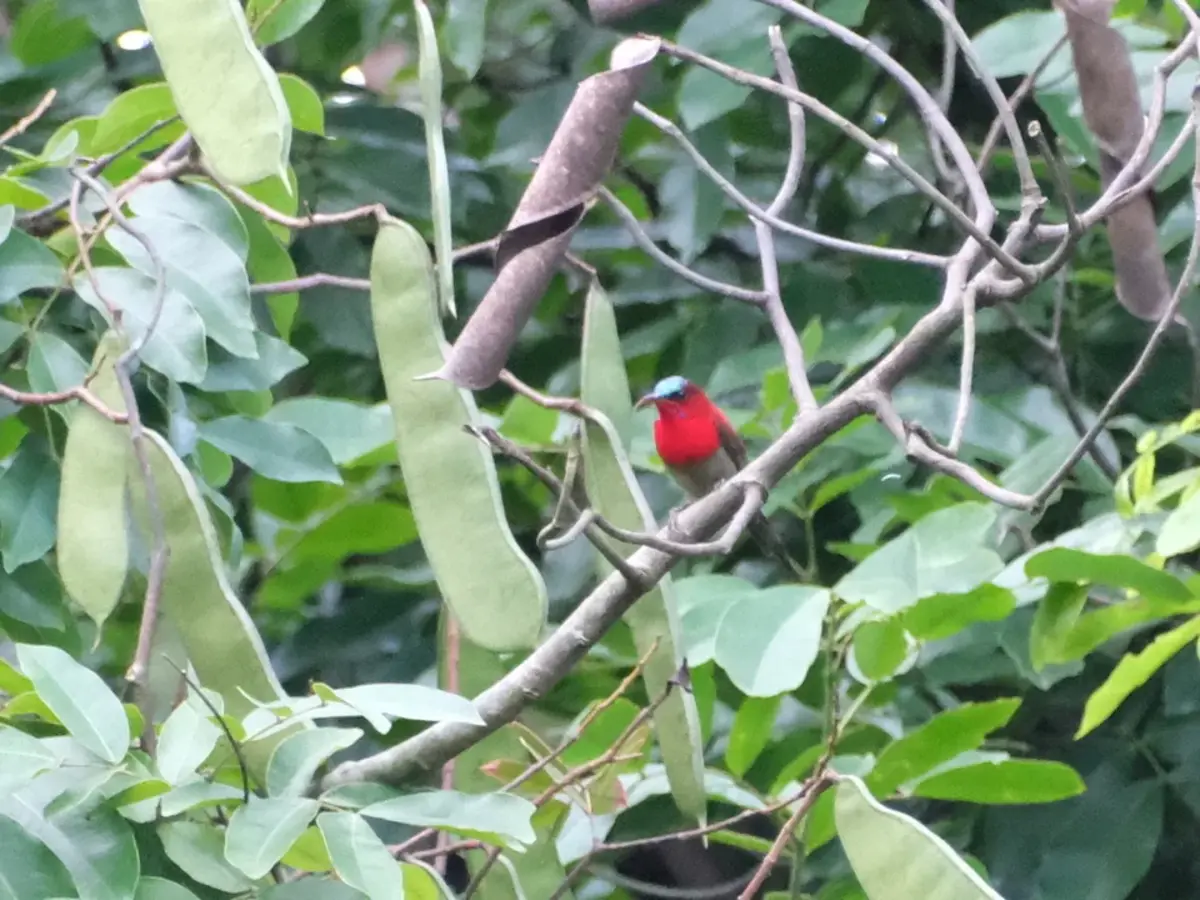
Occurs from the Indian subcontinent through mainland Southeast Asia to the Philippines, Malaysia and Indonesia. It uses forest edges, clearings, secondary woodland, plantations, parks and flower-rich gardens; exact range differs among subspecies. [1–3]
NParks reports a length of about 10–12 cm. Its small size, fine curved bill and short wings suit rapid movement among flower clusters and insect capture in low vegetation. [1]
Males show red head, back and breast, iridescent blue crown and moustachial stripe, dark grey belly and glossy dark tail; females are olive above and pale yellow below. Plumage varies among subspecies, so locality and the full pattern matter more than a single colour patch. [1,2]
A curved bill and nectar-adapted tongue reach deep flowers, while the small body permits use of fine twigs and rapid turns. Bright male colour functions in social signalling; subdued female olive plumage is cryptic near the nest. [1,2]
Behaviour and ecology
Diurnal, usually foraging alone or in pairs and moving agilely among vegetation layers. It may perch to drink nectar, occasionally wing-flick or hover briefly at flowers, and glean spiders and insects from foliage. [1,2]
Diet
Nectar provides rapid energy while spiders and insects supply protein, especially during chick rearing. This mixed diet means the species cannot be maintained on sugar water or artificial nectar alone. [1,2]
Reproduction and life cycle
Builds a suspended pouch nest from plant fibres, moss and spider silk. Historical Borneo records describe two-egg clutches; DinoJura could not verify a current species-level incubation period in the reviewed open sources and does not infer one from other sunbirds. [4]
Ecosystem role
Movement among flowers can transfer pollen and contribute to pollination, while insect predation links the species to small-predator networks in gardens and forest edge. Pollination effectiveness depends on flower shape and feeding behaviour. [1,2]
Threats & conservation
The species is common and tolerant of modified habitat, supporting its LC status, but loss of flowering plants, pesticide use and local trapping can still have local effects. DinoJura should require lawful origin, correct identification and quarantine even though the name was not located in CITES. [1–3,5]
BirdLife lists the species as Least Concern (LC). Aethopyga siparaja was not located in the CITES Appendices effective 5 March 2026; this does not waive native-bird protection, veterinary, import, transport or alien-species rules. [1–3,5]5 sourced facts
Species in five facts
Body length is about 10–12 cm. [1]
Males are brilliant red while females are mainly olive-yellow. [1,2]
The diet includes nectar, spiders and insects. [1]
The species uses forest edge, secondary woodland, plantations and gardens. [1,2]
Historical Borneo records describe two-egg clutches. [4]
Sources
[1] Singapore NParks — Aethopyga siparaja[2] eBird — Crimson Sunbird[3] BirdLife DataZone — Aethopyga siparaja[4] Bulletin of the Raffles Museum — Bornean nesting records[5] CITES Appendices effective 5 March 2026Photo record — wang cai / iNaturalist