
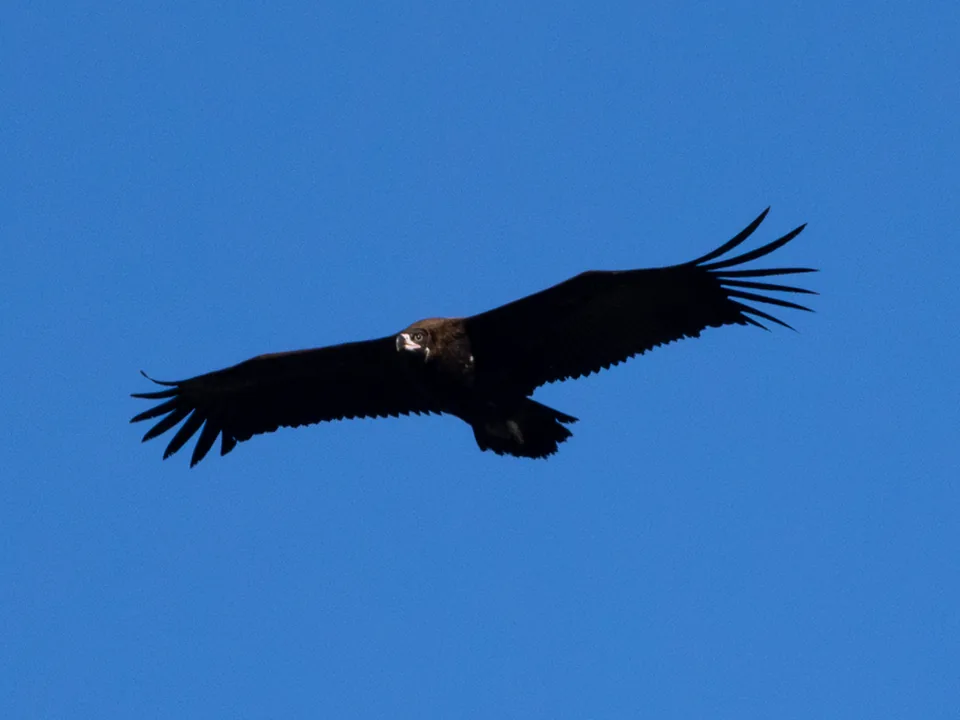
Patchily distributed from Iberia and south-eastern Europe through Central Asia to Mongolia and East Asia. It forages across mountains, steppe, open woodland and broad grasslands, nesting in large trees or on cliffs depending on region. [1,2]
Length is roughly 98–120 cm, wingspan commonly 2.5–2.95 m and mass about 7–14 kg. These are compiled ranges; sex, age, season and weighing method create substantial variation. [2]
The body is nearly uniform dark brown, with long broad wings and fingered primaries, a massive pale-down head and dark neck ruff. Juveniles are usually blacker; in flight the short wedge-shaped tail and rather level wings are useful marks. [1,2]
Broad wings reduce the energetic cost of searching; acute vision detects carcasses and gatherings of other scavengers. Sparse head feathering limits fouling, while the deep powerful bill handles tissue that many other species cannot open. [2]
Behaviour and ecology
It soars for hours on thermals and may search over very large areas. At carcasses, size and a powerful bill allow it to open hide and reach tough tissue, making food accessible to other scavengers. [2]
Diet
Feeds on carcasses of medium to large mammals, often taking hide, muscle and tendons; smaller carrion and occasional weak live prey may also be used. Supplementary food must be screened for veterinary drugs, lead and toxins. [2,3]
Reproduction and life cycle
A breeding pair usually lays one egg in a very large stick nest reused over years. Incubation lasts roughly 50–56 days; the chick spends months in the nest and remains dependent after fledging, resulting in slow natural population growth. [2]
Ecosystem role
Rapid carcass consumption shortens the time decomposing tissue remains exposed and returns nutrients to ecological cycles. By opening carcasses, the species also creates access points for a wider scavenger community. [2]
Threats & conservation
Direct and secondary poisoning, vulture-toxic veterinary drugs, collision and electrocution, lead exposure, food decline and nest disturbance all cause mortality. Operationally, food chains require screening, appropriate health isolation and exclusion of carcasses exposed to risky drugs or lead ammunition. [1,2]
Reviewed 24 September 2026: BirdLife/IUCN records NT; Aegypius monachus is in CITES Appendix II. Management must also consider national law, individual origin, veterinary documentation and shipment-specific permits.5 sourced facts
Species in five facts
Its wingspan can approach 3 m. [2]
A pair usually raises only one chick in a breeding season. [2]
The stick nest may be repaired and reused for many years. [2]
Its powerful bill opens hide and tendons inaccessible to many other scavengers. [2]
Secondary poisoning is a risk even when the bird was not the bait's target. [1,2]
Sources
[1] BirdLife DataZone — Cinereous Vulture[2] Vulture Conservation Foundation — Cinereous Vulture facts[3] CITES Appendices effective 5 March 2026[Ảnh] iNaturalist observation 252947270 — Diego González Dopico, CC BY