
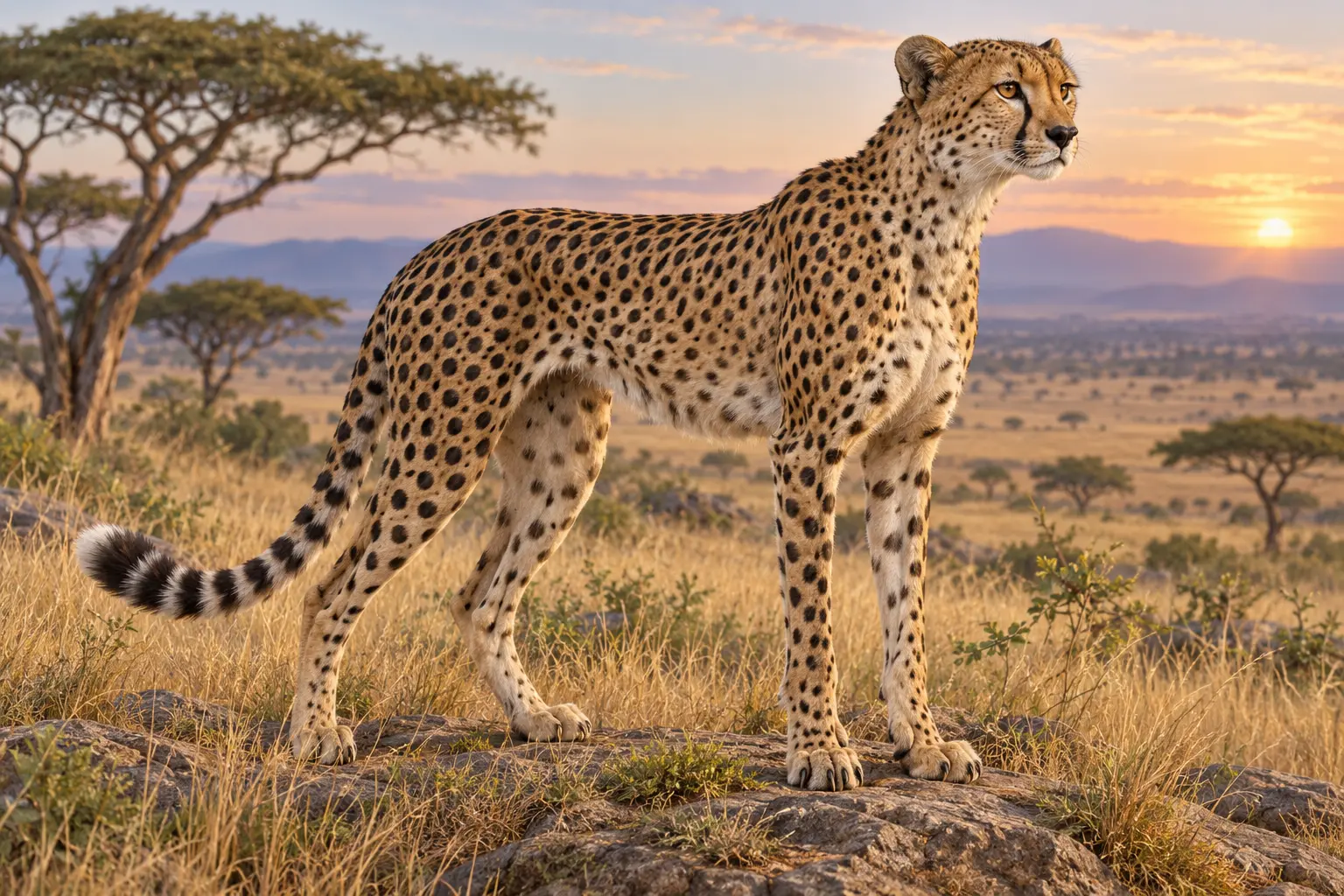
Fragmented populations remain in North Africa, the Sahel, eastern and southern Africa, with a tiny Asiatic population in Iran. Cheetahs use grassland, savanna, scrub, desert and even mountain terrain where space, visibility and prey remain adequate. [1,2]
Smithsonian reports adults at about 34–64 kg, roughly 77 cm at the shoulder, 112–142 cm body length plus a 66–84 cm tail; males are slightly larger. Measurements overlap between sexes and vary by population, so mass alone cannot establish sex or subspecies. [1]
A slender body, deep chest, narrow waist, long legs and small head combine with solid round spots rather than leopard rosettes. Black ‘tear marks’ run from the eyes to the mouth, the tail ends in dark rings and claw tips often register in tracks because the claws are only partly retractile. [1]
A spring-like spine lengthens the stride, mobile shoulder blades and rotating hips extend reach, specialised pads add traction and the tail counterbalances turns. Enlarged nasal passages aid airflow but leave less room for large tooth roots, illustrating an evolutionary trade-off between speed and fighting power. [1]
Behaviour and ecology
Primarily diurnal, especially in early morning and late afternoon, it stalks by sight before a short sprint. Adult females are usually solitary except with cubs; males often form coalitions of two or three, commonly littermates. Cheetahs do not roar but chirp, yelp, growl and purr. [1]
Diet
Carnivorous, taking mainly small to medium antelope such as gazelles and impala, plus hares, ground birds or young larger mammals. Chases are energetically expensive and meals are eaten quickly because lions, hyenas or vultures may displace the cat. [1]
Reproduction and life cycle
Sexual maturity occurs around 18–23 months; gestation is about three months and litters average 3–6 cubs according to Smithsonian. Mothers rear cubs alone; young have a smoky-grey dorsal mantle, begin following hunts around six weeks and learn prey handling over months. Wild cub mortality is very high. [1]
Ecosystem role
As a mesopredator in many savanna systems, cheetahs influence small-ungulate abundance and behaviour while competing with larger carnivores. Conservation requires broad landscape connectivity and healthy prey populations, not only isolated reserves. [2]
Threats & conservation
Habitat loss and fragmentation, prey decline, livestock conflict, roads, isolated small populations and illegal live-animal trade are major pressures. The 2022 IUCN assessment reports a small fraction of the historical range remains occupied; managed populations require pedigrees, subspecies integrity and no promotion of private ownership. [2–4]
Reviewed 1 October 2026: IUCN assessed the species as Vulnerable (VU) in 2022; CITES lists it in Appendix I. Some subspecies or populations, including the Asiatic cheetah, face higher risk than the species-wide category. Any captive-bred origin, transfer or trade exception requires authority confirmation. [2–4]5 sourced facts
Species in five facts
Each animal has an individual spot and tail-ring pattern useful for photo identification. [1]
Top speed is sustained only over a short distance of a few hundred metres. [1]
Tracks often show claw tips, unlike most cats with fully retractile claws. [1]
Males may remain in lifelong coalitions while adult females are usually solitary. [1]
The species is in CITES Appendix I; international commercial trade in wild specimens is generally prohibited. [3,4]
Sources
[1] Smithsonian's National Zoo — Cheetah[2] IUCN Red List 2022 assessment — Acinonyx jubatus[3] Convention on Migratory Species — Acinonyx jubatus[4] CITES Appendices effective 5 March 2026